Background
Delirium is a serious, often preventable neurocognitive condition characterised by fluctuating disturbances in attention, awareness and cognition.1 People with delirium can experience distressing symptoms like hallucinations, delusions, and mood changes, with significant impact on family carers.1–3 Delirium in hospital leads to prolonged hospital stays, functional and cognitive decline, new diagnoses of dementia, and premature death.1,2,4 Despite advances in hospital-based screening and prevention, delirium affects around one quarter of older people (>65 years) during acute care episodes.1 Persistent or recurrent episodes are linked to worsening cognitive and functional outcomes and loss of independence, as well as higher rates of residential aged care placement, frequent hospital readmissions, and increased post-discharge mortality.2,4
Non-pharmacological multicomponent interventions are the ‘gold standard’ for delirium prevention and treatment in hospital,5 comprising components such as orientation, cognitive stimulation, sleep hygiene, mobilisation, sensory support (vision/hearing aids), hydration and nutrition, pain management and polypharmacy review.5,6 When these are systematically implemented as part of a multicomponent program during an acute hospital admission, incident (i.e. hospital-acquired) delirium can be reduced by 50% and falls reduced by 64%, with additional benefits such as reducing hospital length of stay (LOS) and placement into residential aged care.7
However, delirium risk and episodes frequently extend beyond hospital admissions, arising prior to hospital presentation and persisting after hospital discharge.8,9 Point prevalence estimates in community settings range from 0.2% to 8.3% among general older populations, rising to 1.4% to 44.1% in those with frailty receiving home or primary care.10 Estimates of delirium prevalence at presentation to the emergency department (ED) is 10% to 20%,11 and an estimated 22% to 51% of hospital cases still have persistent delirium symptoms at hospital discharge.12 Delirium recurrence rates in community contexts are not well quantified, but studies suggest recurrence is common.13,14
As healthcare delivery shifts toward community-based care models, with an emphasis on primary care management and smoother transitions between settings,15–17 questions remain about whether delirium prevention can or should be implemented in community settings, and if so, when, for whom and how. Existing guidance and syntheses largely centres on acute care settings. Moreover, the components that drive the effectiveness of delirium prevention programs are based on hospital-derived factors known to predispose older people to delirium during hospitalisation. It is unclear whether these same components, or their underlying mechanisms, are relevant (or effective) in community settings, where the risk profile and contextual influences may differ substantially. This scoping review addresses this gap by mapping peer-reviewed literature on multicomponent non-pharmacological interventions for delirium prevention delivered in community settings.
Methods
This scoping review adhered to the Preferred Reporting Items for Systematic Reviews and Meta-Analyses extension for Scoping Reviews (PRISMA-ScR) guidelines,18 and was guided by the following research questions (RQ):
RQ1: Which populations have been targeted by community-based delirium prevention interventions, and what does this suggest about who is considered at risk of delirium in the community?
RQ2: How have multicomponent delirium prevention interventions been designed and delivered in community settings?
RQ3: What prevention components have been included and how do they align with existing delirium prevention frameworks?
RQ4: How and when was delirium assessed in the community? What happened when delirium was detected?
A scoping review was chosen because the research questions are exploratory and descriptive, aiming to map the extent, range, and nature of existing evidence rather than to evaluate effectiveness.19 The purpose was to clarify concepts, identify knowledge gaps, and synthesise how interventions align with recognised frameworks.
Data sources and searches
The databases Medline (Ovid), Embase, PsycINFO, CINAHL, Web of Science, and Cochrane Library were searched in February 2025, with no date limitations, for keywords and MeSH terms (where applicable) related to Delirium and Prevention. The search strategy was drafted by the lead author (Layla M. Edwards) and further refined through team discussion. The final search strategy for Medline is shown in Supplementary File 1, Figure S1. Search results were imported into EndNote X7 (Thomson Reuters, New York, NY, USA) and then exported to Covidence systematic review software (Veritas Health Innovation, Melbourne, Australia), where duplicates were removed automatically.
Study selection
Peer-reviewed empirical studies were included if they delivered a non-pharmacological intervention intended to prevent delirium in adults (>18 years) in a community setting (i.e., not in hospitals, residential care or other institutional settings). No limits were applied to the comparator or the outcome.
Papers were excluded if they were published in a language other than English, focused on a paediatric population (<18 years), or if the intervention was delivered within institutional care settings, including hospitals, community palliative care/hospice, or residential aged care. Case studies, protocols and commentaries/editorials were also excluded. All types of reviews were included up to full-text screen to allow scanning of the reference lists for additional sources, after which they were excluded. Two investigators (Layla M. Edwards, Amy Montgomery) independently applied the eligibility criteria. Discrepancies were resolved by consensus. A third investigator (Kimberley Campbell) systematically assessed the reviews during full-text screening.
Data extraction and synthesis
The general study characteristics (e.g., author, year of publication, study location and study design) were extracted from the included studies. The TIDieR checklist20 was used to capture and describe target populations (RQ1), intervention design and delivery (RQ2), intervention components (RQ3), and delirium assessment schedules and detection protocols (RQ4). Given the anticipated heterogeneity of multicomponent interventions, the PINCHES ME Kindly framework was used as a pragmatic classification framework to group intervention components into clinically relevant domains.21 The framework comprises: Pain, Infection, Nutrition, Constipation, Hydration, Exercise (and mobility), Sleep, Medication, Environment and, Kindly (being calm, patient and mindful of emotional needs), and is commonly used as a mnemonic to prompt assessment of modifiable delirium risk factors.21 Three investigators (Layla M. Edwards, Amy Montgomery, Kimberley Campbell) collaboratively extracted data from all studies. Intervention components were extracted by Amy Montgomery, a nurse practitioner with expertise in delirium. All extracted data were cross-checked by Layla M. Edwards.
Tables were generated to report study, population and intervention characteristics. Extracted data were narratively synthesised to provide an integrated overview of the evidence. In keeping with scoping review methodology, we did not assess included articles for risk of bias.18
Results
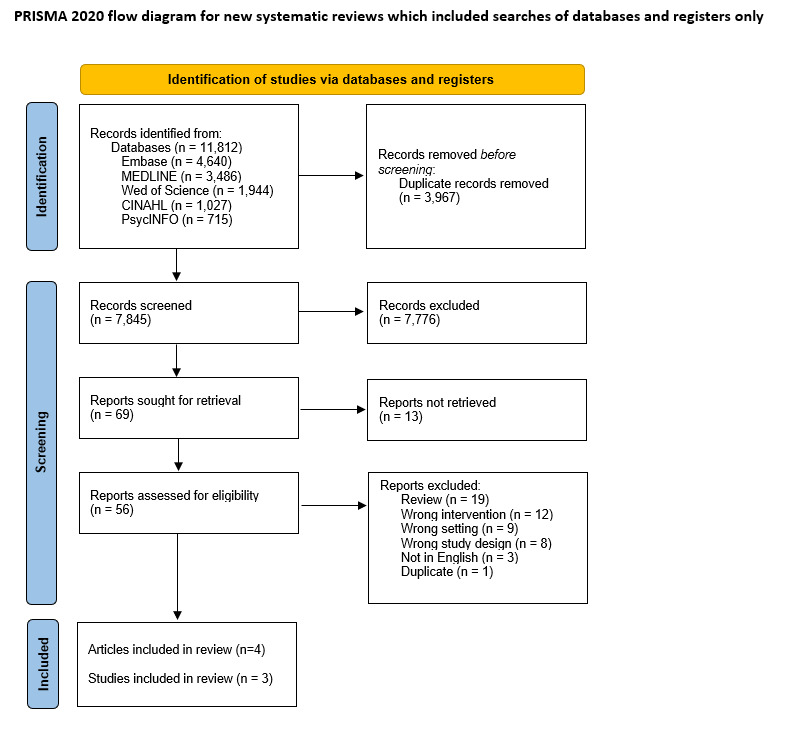
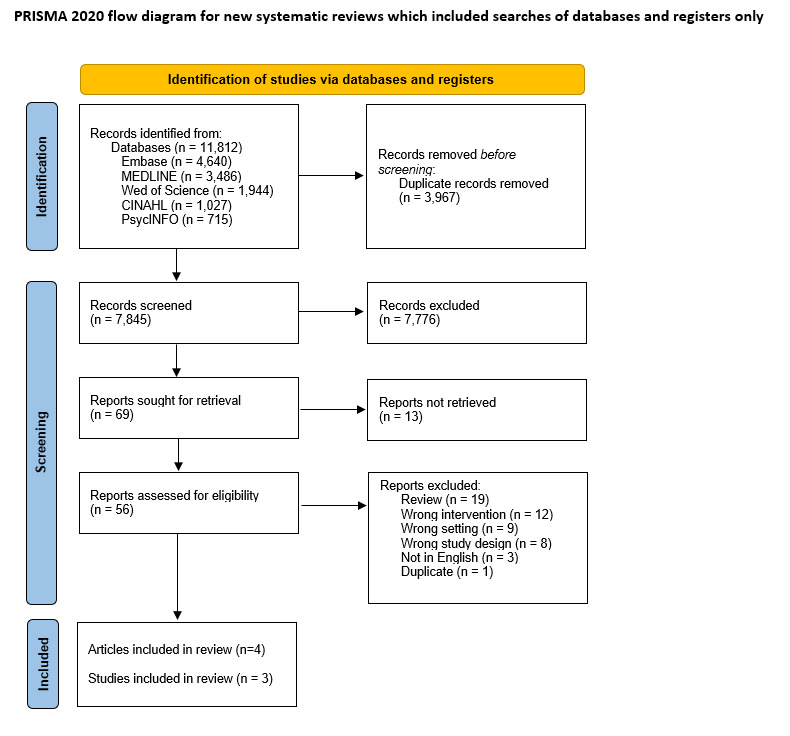
After removing duplicates, 7,845 titles and abstracts were screened; 56 proceeded to full-text review, and four articles describing three studies met the inclusion criteria (Figure 1). One randomised controlled trial (RCT) yielded two articles with different outcomes22,23; as such, each article is included to ensure complete reporting, but the results synthesis considers this as one study.22,23
Study characteristics
Studies were published between 200624 and 2016,22,23 one each from Australia,24 Italy25 and Switzerland22,23 (Table 1). Study designs included a RCT,24 a pilot RCT,22,23 and a controlled trial25 (Table 1 and Supplementary File 2, Table S1).
Target Populations
All studies shared a common premise: hospitalisation in frail older people (>65 years) precipitates delirium through environmental factors contributing to disorientation, immobility, sensory deprivation, and iatrogenic stressors22–25 (Table 1 and Table S1). As such, all studies targeted older people with frailty transitioning from acute care to a geriatric rehabilitation ward24,25 or to the community with a home care prescription.22,23
Eligibility to participate varied across studies: in Caplan et al. (2006), community-dwelling older people who had been hospitalised for >6 days, referred for geriatric rehabilitation, medically stable, and expected to return home following the rehabilitation phase were eligible. Whilst they specified older people as a criterion, they did not define any age parameters for eligibility.24 In Isaia et al. (2009), eligibility included community-dwelling people aged ≥75 years admitted from the ED with an acute illness, had a carer, and were referred for geriatric rehabilitation. Participants were required to have no probable or definite delirium at enrolment but to have 1-4 risk factors according to Inouye’s risk model.26 The risk model identifies four predisposing factors: pre-existing cognitive or sensory impairment, severe illness, and dehydration.25 In Verloo et al. (2015, 2016), eligibility included home-dwelling people aged ≥65 years and discharged from hospital with a medical prescription for home care. They were excluded if they had any outpatient treatment still ongoing and if they lived outside the study reach.22,23
Intervention design and delivery
Two studies designed interventions to reduce exposure to hospital-related delirium triggers via early hospital discharge models,24,25 and one study designed an intervention to promote delirium prevention and early detection after hospital discharge22,23 (Table 1, 2, and Table S1). All interventions were delivered face-to-face, in participants’ homes.22–25 Two interventions were delivered by trained, multidisciplinary teams (MDT), reflecting approaches designed to replicate or complement hospital-based geriatric care.24,25 In contrast, Verloo et al. (2015) employed a single geriatric clinical nurse (GCN) to implement a structured delirium-prevention and detection program.22,23
Across studies, the intervention commenced after participants were discharged from hospital and returned home.22–25 In two studies, the intervention began the same day as hospital discharge24,25 and in the other, within 48 hours of discharge.22,23 However, the dosage and duration of the interventions varied across the studies. Participants in Caplan et al. (2006) received the intervention daily for the length of rehabilitation (mean of 15.97 ± 9.37 days)24; in Isaia et al. (2009), participants were visited three times per day for the duration of rehabilitation (mean of 19.1 ± 9.5 days).25 Participants in Verloo et al. (2015/16) received five structured home visits over one month (at 48 h, 72 h, and 7-, 14-, and 21-days post-discharge), each lasting 30-60 minutes.22,23 All studies included a follow-up, ranging from one22–24 to six months24 post-discharge.
All studies included a control arm. In two studies, control participants were transferred to a geriatric rehabilitation hospital ward where they received comparable care to that of the intervention.24,25 In the remaining study, control participants received comprehensive homecare provided by community nurses. This care varied based on the participant’s clinical status, the presence of carers, and the skill mix of the community nursing staff, and did not include a structured delirium prevention protocol.22,23
Intervention components
Interventions included a combination of core elements aligned with the PINCHES ME Kindly framework (Table 2 and Table S1). The number of included components varied from four24 to all nine components of the framework.22,23 Constipation and hydration, exercise and mobility, and addressing participants emotional needs were the most consistently applied components across all interventions.22–25
Caplan’s et al. (2006) “Hospital in the Home” focused on minimising delirium risk, delirium education, and supporting carers, tailored to participant’s physical capability and recovery needs. The intervention emphasised early mobility and provided physiotherapy, mobility and medical equipment as required.24 Isaia’s et al. (2009) intervention “The Geriatric Home Hospital Service” included reorientation, risk reduction, nutrition, sleep, exercise, and carer support. While participants were visited three times per day, not all intervention components were repeated; exercise was delivered three times per day, reorientation/cognition activities twice daily, and the evening visit focused on sleep. The delivery of the remaining components were adjusted based on participants’ functional, cognitive, and nutritional status.25 Verloo’s et al. (2015, 2016) intervention22,23 included orientation, environmental adjustments, risk reduction, sleep hygiene, mobility and social support.22,23 Printed educational leaflets were provided to participants and carers, and a structured user guide outlining the 15 intervention components across six domains to standardise delivery. Tailoring was explicit and central to the nurse-led intervention, based on real-time assessments of delirium symptoms, physical health, and environmental or carer factors.22,23
Delirium assessments
Delirium incidence was assessed using the Confusion Assessment Method (CAM) tool in all studies22–25 (Table 1 and Table S1). The CAM was administered by the trained MDT,24 experienced physicians25 or by the GCN,22,23 at baseline22–25 and at post-baseline timepoints ranging from: every 48 hours,24,25 “as needed”, based on clinical recognition of confusion,25 during the five structured visits with the month post-discharge (48 and 72 hours, and at 7, 14 and 21 days), at the end of rehabilitation24 and at follow-up.22,23
All studies reported delirium management protocols. In Caplan et al. (2006), delirium was managed via a protocol-led medical reassessment, hospital readmission if needed or intensified home-rehabilitation monitoring, alongside CAM assessments every 48 hours.24 Isaia et al. (2009) increased assessment frequency when confusion was observed, combining symptom-triggered and scheduled evaluations. Physicians documented CAM findings, severity scores, precipitating factors, and non-pharmacological management, overseeing all clinical decisions.25 In Verloo et al. (2015, 2016), the GCN provided reassurance, education, safety monitoring, and escalated to the family physician if deterioration occurred.22,23 None of the studies reported the clinical features or precipitating factors for incident delirium, only incidence rates.
Discussion
This scoping review mapped the design, delivery, and monitoring of multicomponent, non-pharmacological delirium prevention interventions in community settings, examining how delirium risk is conceptualised and prevention approaches are operationalised outside inpatient settings. Four articles were included that described three community-based delirium prevention interventions and participant groups. In all studies, participants were identified during a hospitalisation, with delirium prevention activities commencing after discharge. As findings are limited to post-hospitalisation samples, it remains unclear how delirium risk is defined prior to admission or in those not recently hospitalised (RQ1).
Two studies attributed delirium risk to age, frailty and to environmental and iatrogenic stressors associated with acute care settings.24,25 Notably, these studies primarily evaluated early discharge (“hospital at home”) models in which participants received comparable multicomponent care either at home or in hospital, suggesting that any observed differences in delirium outcomes may partly reflect avoidance of hospital-related exposures rather than the specific effects of the intervention components. While this interpretation is consistent with the hypothesis that hospitalisation may itself be deliriumogenic,27,28 it is also possible that individuals who are able to remain at home or who are discharged earlier differ from those requiring longer hospitalisation in terms of medical complexity, functional status, or other characteristics associated with delirium risk. As a result, differences in baseline vulnerability may have contributed to the observed outcomes. Furthermore, this interpretation does not account for pre-existing community-based risk factors that contribute to vulnerability before a hospital admission, nor does it address factors that may persist or emerge following discharge.27,29 As such, while reducing exposure to hospital-related stressors may represent one potential preventive mechanism, further research is needed to identify the community-based determinants of delirium risk and the intervention components required to support prevention before and after episodes of acute illness and hospital admission.
The third study explicitly stated that older people were at increased risk of delirium following hospitalisation without clearly articulating the mechanisms underpinning this risk.22,23 Consequently, these findings do not clarify who might remain at risk of delirium following hospital discharge (RQ1), highlighting a gap in understanding post-discharge risk profiles. There is no longitudinal data describing who remains at risk, how risk changes over time, or when interventions (and for whom) are most needed.30–32 This evidence gap limits appropriate targeting and intervention design, particularly when based on inpatient risk assessments7,33,34 (RQ1, RQ3).
Although all studies were identified as delirium prevention interventions, Verloo et al. (2015, 2016) incorporated processes for early detection and management of incident delirium, highlighting the practical overlap between prevention, monitoring, and treatment strategies in community-based care. No intervention was specifically designed for community-dwelling older people; instead, they drew on established hospital-based theoretical frameworks, such as the Hospital Elder Life Program (HELP) and related multicomponent models,30,35 and tailored components based on individual needs, not setting (RQ2, RQ3). The efficacy of these models is well established in acute hospital settings,7,36 and the core components selected are widely recognised as essential to maintaining functional independence, supporting recovery, and improving quality of life following hospitalisation.37,38 However, there is no evidence they are effective outside acute care, and adaptation would likely be required,39 which did not occur. Future research should focus on identifying post-discharge delirium risk profiles and community-based triggers for delirium onset/recurrence, to inform the development of context-appropriate interventions that target modifiable risks in the community.
In two studies, MDTs visited participants one-to-three times daily for rehabilitation length24,25; whereas the remaining study was nurse-led, comprising of five scheduled sessions within 21 days of discharge22,23 (RQ2). While MDT-led interventions can address multifactorial risk35,40,41; they require substantial workforce capacity, complex interdisciplinary coordination, and sustained funding, which constrains scalability.40,42,43 Nurse-led models may offer greater feasibility in community care; however, given delirium’s acute onset and fluctuating course,30 intermittent assessments risk missing transient episodes, limiting both timely detection and opportunities for effective intervention.37,44 Moreover, all included interventions were dependent on geographic proximity, limiting accessibility to people living outside catchment areas. Emerging caregiver-supported models have demonstrated the feasibility of engaging family carers in post-discharge delirium prevention and monitoring, suggesting a potential role for carers in extending delirium care and surveillance beyond formal healthcare contacts.45 Family-led (where available) or community-led approaches, combined with remote or virtual monitoring, may be better suited to community settings, mitigating resource and location constraints, while enabling earlier detection escalation beyond structured visits.37,46–48 However, reliance on informal carers may also present challenges. Older adults aging alone are increasing in number globally,49,50 and when available, many carers themselves are frequently older adults or medically vulnerable, which can limit caregiving capacity.51–53 Consequently, caregiver-supported approaches may not be suitable or accessible for all populations. Future research should consider how delirium prevention interventions can be designed to accommodate varying levels of caregiver availability and support, and how prevention strategies can be delivered equitably to individuals who lack informal caregiving networks, with particular focus on feasibility, acceptability, fidelity, equity, and effectiveness for early delirium detection and escalation in community settings. Finally, delirium assessment in community care is not systematically implemented and remains far less established than acute care settings. This is evident by the fact that there is little understanding of and data on delirium outside of acute care settings.54 Although emerging implementation frameworks for community delirium care have been proposed, including recommendations for screening (via the 4AT or FAM-CAM), assessment and management pathways, empirical evidence evaluating their effectiveness and implementation remains limited.54–56 Importantly, none of the studies included in this review evaluated routine implementation of screening or care pathways in community practice. Addressing this evidence gap represents a key priority for future research, particularly to determine the feasibility, effectiveness, and scalability of community-based delirium detection and management strategies.
The assessment schedules in the included studies that could reliably detect delirium,24,25 required intensive workforce input that is rarely available outside research or specialised outreach programs57 (RQ4), highlighting a major challenge in ongoing delirium surveillance once patients are discharged or formal interventions cease. When delirium was detected in the included studies, responses were primarily limited to referral to appropriate healthcare services or hospital readmission. However, these studies did not report the clinical characteristics, precipitating factors, or aetiology of delirium episodes. This limits the understanding of potentially modifiable triggers and hinders the development of targeted prevention strategies. Future studies should report such characteristics to clarify risk profiles, identify recurrent mechanisms, and evaluate how emerging community delirium frameworks and pragmatic screening approaches can be integrated into routine care.
Limitations
This review has several limitations. Consistent with scoping methodology, we did not assess the methodological quality or effectiveness of included studies, limiting causal inference. Restriction to peer-reviewed, English-language literature may have excluded relevant grey literature, service models, or non-English studies, resulting in potential publication and selection bias. In addition, this review focused on interventions explicitly designed to prevent delirium in community settings. Consequently, broader community-based, transitional care, and post-discharge interventions that may have reported delirium outcomes but were not developed with delirium prevention as a primary objective, may not have been captured. Future research should examine delirium outcomes embedded within broader community and transitional care interventions, including programs designed to support hospital avoidance, facilitate earlier discharge, or optimise transitions between acute and community care, to better understand their potential contribution to delirium prevention outside acute care settings and how relevant strategies have been operationalised in the community.
The review identified only three unique studies, all of which were conducted more than a decade ago. As a result, the findings may not fully reflect current clinical practice, healthcare systems, or advances in delirium prevention and management. Heterogeneity in intervention components, terminology, and reporting further constrained synthesis. Finally, the evidence base remains predominantly hospital-orientated, with limited evaluation of delirium prevention strategies within routine community care and little guidance regarding how existing approaches may be adapted, implemented, and sustained in community settings. Future research should examine how delirium prevention strategies can be tailored across the continuum of care and for diverse community-dwelling populations, including individuals who may avoid hospital admission through effective community-based support, those who may return home earlier from hospital settings, those requiring interventions to support safe transitions between care settings, and people living alone or with limited informal caregiving support. Contemporary, methodologically robust studies are needed to determine which approaches are feasible, acceptable, and effective for different population groups.
Conclusions
This review highlights a limited and fragmented evidence base for delirium prevention in the community. The post-discharge period represents a critical but poorly understood window of vulnerability among older people. Existing interventions have largely translated hospital-based multicomponent approaches into community settings, with limited evidence to guide how prevention should be adapted to post-discharge risk profiles. Although emerging community delirium frameworks and pragmatic screening approaches have been proposed, their implementation and effectiveness in post-discharge care remain largely unevaluated. Future research is required to address this knowledge gap, so that future multicomponent delirium prevention interventions can target those most at risk of delirium post-discharge and include the most appropriate components to reduce that risk. Furthermore, no studies examined delirium occurring in the community prior to hospital admission, limiting understanding of pre-hospital risk factors and pathways into acute care. Addressing these gaps will be essential to developing scalable and equitable delirium prevention models that span the full continuum of care.
Data availability
This scoping review used data from published studies, all of which are cited. The extracted data supporting the review are included in Tables 1 and 2, and Supplementary Files.
Funding sources
Dr Layla M. Edwards, Dr Amy Montgomery and Ms Kimberley Campbell received salary support from National Health and Medical Research Council Investigator Grant (GNT2027033 awarded to Agar).
Competing interests
None to declare
Editorial disclosure
Meera R. Agar is a member of the Editorial Board of Delirium. The manuscript was handled by the Editor-in-Chief, Alasdair MacLullich, who made the acceptance decision.
Ethics and consent
Ethics approval and participant consent were not required as this study was a scoping review of previously published literature.
Author contributions
Layla M. Edwards: conceptualisation, methodology, data curation, formal analysis, visualisation, investigation, resources, project administration, supervision, writing-original draft. Amy Montgomery: conceptualisation, methodology, formal analysis, investigation, writing-reviewing and editing. Kimberley Campbell: data curation, writing-reviewing and editing. Alison Mudge, Rayan Saleh Moussa, Vanessa Yenson, Annie Hepworth: writing- reviewing and editing. Meera R. Agar: conceptualisation, writing-reviewing and editing. All authors reviewed and approved the final manuscript.
Review protocol registration
A review protocol was not registered.
Generative AI use
No generative AI tools were used in the conduct of this review or preparation of the manuscript.