Introduction
The acute neurocognitive condition of delirium1 affects one in four hospitalised patients.2 Delirium is often distressing3 and debilitating.4,5 The primary approach to resolving delirium is to identify and treat its underlying causes, so these clinical actions are key when symptoms present.6 However, delirium care in hospital does not always align with best practice.7,8
Nurses’ 24-hour presence make them well placed in the interdisciplinary team to respond to acute changes in patients’ cognition9,10; as does their scope of practice, which includes comprehensive assessment, interpretation of diagnostic results, care planning, delivery and evaluation, provision of information and support, and collaboration with other healthcare providers.10 While much is reported about nurses’ challenges and experiences of delirium screening and other aspects of delirium care,11,12 little is known about how they respond clinically to positive delirium screens.
The study objective was to audit the medical records of acute care patients with at least one positive delirium screen during hospital admission, to determine the extent and nature of subsequent interdisciplinary delirium care and nurses’ contribution to that care.
Methods
A retrospective medical record audit of delirium care as per the Australian Delirium Clinical Care Standard (‘Delirium Standard’),6 conducted in a 300+ bed tertiary hospital in Perth, Western Australia that uses mostly paper and some electronic documentation. The Delirium Standard is a clinical care standard with eight quality statements applicable to patients at risk of or with delirium in Australian hospitals.6
The hospital’s related delirium guideline specifies the 4 'A’s Test (4AT)13 as the primary delirium screening tool. The 4AT allocates scores of 0-4 per item, with an overall maximum of 12. In the validated tool, total scores indicate: 0: unlikely delirium or cognitive impairment; 1-3: possible cognitive impairment; ≥4: possible delirium +/- cognitive impairment. Consistent with evidence of the 4AT’s high specificity,14 the hospital’s delirium guideline specifies clinical actions for all patients with a score of ≥1.
Textbox 1 outlines the Delirium Standard’s quality statements and related clinical actions required at the study site.
A Health Information Services officer retrieved medical records of patients who received acute inpatient care and were discharged between March 9 and May 9, 2024, with at least one 4AT score ≥1 during admission; SL confirmed record eligibility.
The audit tool was based on another Delirium Standard-aligned study.15 Adaptations included focusing on quality statements 3-8 (as the current study was of documented delirium care for patients with a positive delirium screen, not of all aspects of delirium care for all at-risk patients), and adding sub-questions for each of the statements, including which health care profession provided the aspect of care. Audit items were patient age, sex, Indigenous status, principal language, primary diagnosis, ward, clinical speciality, admission and discharge dates, discharge status (Supplementary file 1). An audit guide was developed to minimise measurement bias (Supplementary file 2).
SL and JB independently piloted the audit tool and guide against two medical records, finding no disagreements. SL completed 50 audits, with JB independently auditing five random records. Subsequently, data collection was refined for carer engagement, comprehensive assessment, and discharge planning, with SL re-auditing the first 50 medical records. At 100 audits, JB independently audited five records, finding 100% agreement. Data were directly entered into a REDCap (Research Electronic Data Capture) database hosted by the hospital.16,17
The sample size was based on an estimate that no more than 17.5% of medical records would evidence all relevant aspects of the Delirium Standard, derived by averaging the lowest item compliance in two previous audits: one local (25%), the other published (10%8); thus, 222 medical records were determined to be within 5% of the true population with 95% confidence.
Outcomes were the proportion of medical records with documented care meeting all relevant aspects of the Delirium Standard; number and proportion meeting each aspect; and number and proportion where nurses contributed. Descriptive analyses were performed in REDCap and Microsoft Excel.
Ethical approval was by St John of God Health Care Human Research Ethics Committee (ref. 2164) with cross-institutional ratification from the University of Notre Dame Australia (ref. 2024-038). Waiver of patient consent was granted, given the low study risk18 and protection of patients’ confidentiality via secure data storage.
Results
Interim analysis of the first 100 audits (June-August 2024) found lowest item compliance was 4.5% (comprehensive discharge planning), making it clear our anticipated 17.5% overall adherence was an over-estimate. The sample size was accordingly recalculated, with the existing 100 determined to be within 3% - 4% of the true population with 95% confidence and thus sufficient.
The final sample (N=100) included males (48%) and females (52%) with a median [IQR] age of 83 [13.25] years; most were non-Indigenous (91%) and English speaking (89%). Patients had a wide range of principal diagnoses and treating clinical specialities (Table 1). Six patients died during admission (none had delirium diagnosed); the remaining 94% were discharged home or elsewhere. Across the 100 medical records, 53 documented a first 4AT score of 1-3 (possible cognitive impairment, no delirium) and 47 of ≥4 (possible delirium +/- cognitive impairment). Twenty-two records (22%) contained a delirium diagnosis made by a medical officer.
Outcomes
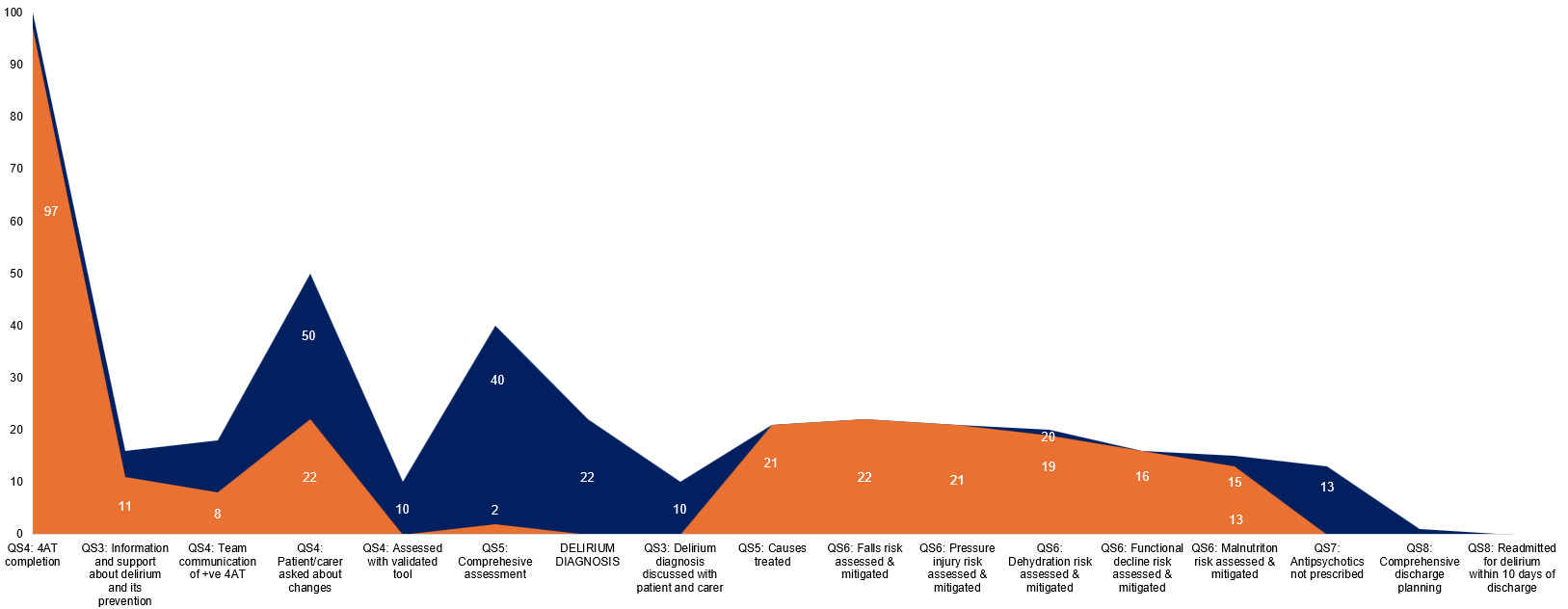
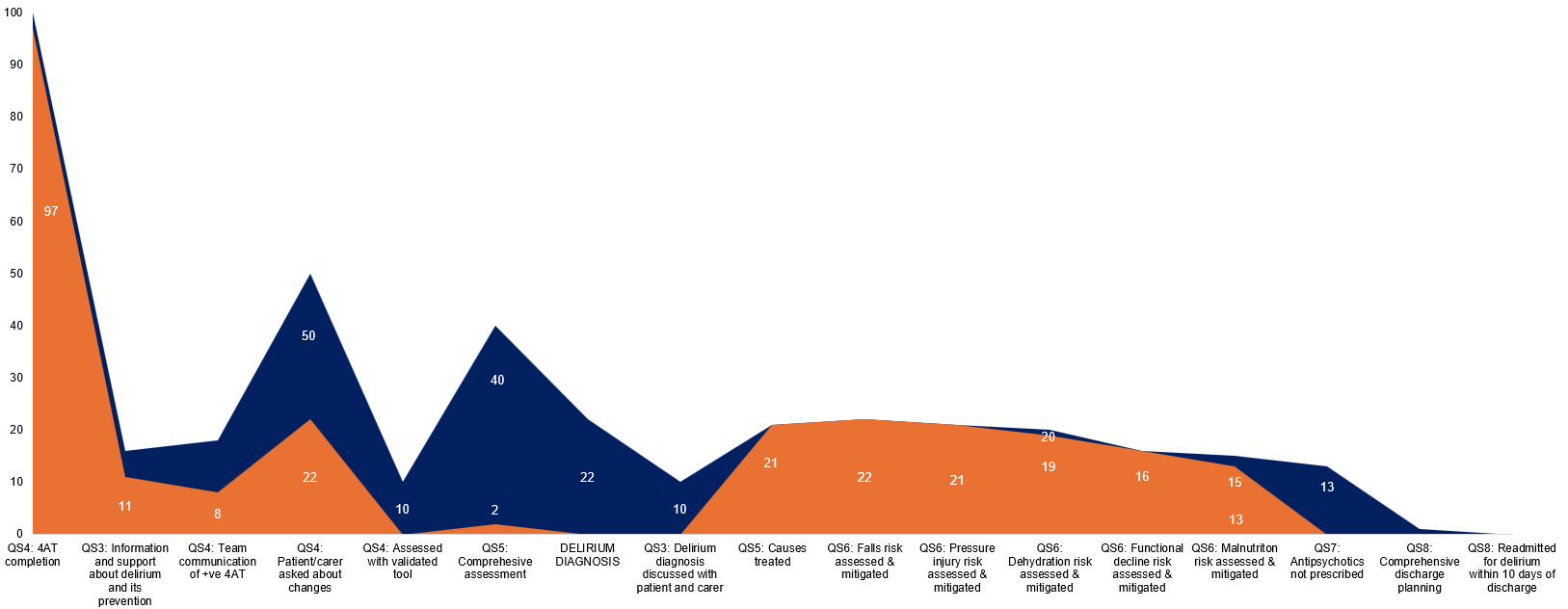
There were no medical records that demonstrated documentation of all relevant aspects of the Delirium Standard. Regarding its individual aspects, 40% of medical records evidenced comprehensive assessment following a positive delirium screen. In the 78 medical records with no delirium diagnosis, delirium was explicitly ruled out in one, where the positive 4AT (i.e. any score >1) was attributed to a pre-existing cognitive impairment. In the 22 records containing a delirium diagnosis, this was discussed with the patient and/or carers in 10 cases (45%). Twenty-one of the 22 records (95.5%) specified underlying delirium cause/s, all of which were treated; and most recorded risk assessment and mitigation for potential related complications (Figure 1). Just over half of records (59%) contained no antipsychotic prescription for delirium (per the Delirium Standard); just one (4.5%) had a comprehensive discharge care plan relevant to delirium.
Nurses documented 97% of the positive 4AT scores, but no subsequent delirium assessment using a validated tool (all 10 were performed by occupational therapists). Nurses were recorded as communicating the positive 4AT score within the interdisciplinary team in 8 of 18 recorded instances (44%); asking the patient and/or their carer about acute cognitive and behavioural changes in 11 of 50 instances (22%); and undertaking comprehensive assessment in 2 of the 40 recorded instances (5%). Nurses documented treating identified delirium cause/s in all 21 recorded instances (included administering antibiotics, antivirals, aperients, and oxygen; managing medications post-overdose; and indwelling catheter insertion for urinary retention); and in almost all risk assessment and mitigation for other complications (Figure 1). There was no record of nurses discussing the delirium diagnosis with patients and their carers, actively avoiding antipsychotic use, or planning delirium care post-discharge.
Discussion
An audit of interdisciplinary and nursing care of 100 patients receiving acute care in hospital following a 4AT of >1 found no medical record with all relevant aspects of Delirium Standard care documented, despite closely corresponding hospital guidance. Most documentation gaps related to comprehensive assessment and communication between team members, patients and carers about the positive screening and/or diagnosis, including 77% of the cohort having no record of delirium being explicitly ruled out. Of 22 patients diagnosed with delirium, 21 had underlying causes identified and treated, almost all had actions to avoid other complications, and just over half avoided antipsychotics, yet only one had a plan for delirium care post-discharge. Nurses documented almost all the positive delirium screens, administration of delirium treatments, and attendance to patient safety, but seemingly played a minor role in other aspects of Delirium Standard care.
A quasi-experimental study to implement the Delirium Standard in another tertiary hospital found similar low documentation of most aspects at baseline (6-67%), except screening and management of related complications (>80%)8; documentation there improved after introducing delirium care policy, procedures, a clinical form, staff education, and patient information resources (although information for carers and discharge planning for delirium remained low - both <20%).8 Another Delirium Standard implementation study in three palliative care units found significantly improved documentation of six of the 12 items (including avoided psychotropic medications) after introducing a delirium monitoring system. Additionally, that study also reported reduced odds of delirium and greater odds of prevented complications for patients with delirium.20 These studies suggest embedding the Delirium Standard in hospital settings with good effect can be achieved through active implementation.
One point of difference is that these previous studies did not involve examination of the documentation of nurses’ contribution to interdisciplinary Delirium Standard care; this study did and found the full scope of nursing practice was not demonstrated. As noted above, nurses’ scope encompasses assessment, interpretation of diagnoses, care planning, delivery and evaluation, provision of information and support, and collaboration with others in the team,10 all of which are directly relevant to delirium care. Literature on nurses’ delirium practices predominantly points to their under-capabilities (especially insufficient knowledge), and yet barriers to nurses working to scope of practice also include organisational and regulatory constraints and role confusion.12,21 For example, Coyle, Burns and Traynor22 found that nurses did not consider delirium or cognitive assessments their role but that of occupational therapist, medical staff or specialist aged care nurses; while Green et al23 flagged clinician’s uncertainty about their specific roles and responsibilities as a barrier to delirium care and communication, including with carers.
A strength of our study was the single auditor using a standardised, pre-tested and piloted audit tool and guide with reliability checks by another author to minimise measurement bias. Limitations include that the study was retrospective at a single hospital in 2024, so results may not be generalisable to other hospitals nor reflect current practice. The audit did not assess quality or outcomes of clinical interventions, only their documentation. Restricting the denominator to 22 patients with a delirium diagnosis for many of the measures likely overestimated the proportions of patients who received relevant Delirium Standard care, given the indefinite delirium status of almost all the remaining cohort and the likelihood (considering the 4AT’s high specificity14) that many more required this care.
In conclusion, more active strategies than a Delirium Standard-aligned hospital guideline alone are needed to demonstrate patients with a positive delirium screen receive relevant follow-up care. This audit also identified nurses’ varied contribution to delirium care following a positive delirium screen, indicating some misalignment with their scope of practice and thus a potential target area for ongoing quality improvement within the organisation.
Acknowledgements
The authors acknowledge the support of St John of God Health Care and the Commonwealth Government of Australia for SL to undertake the medical records audit under the supervision of AH, JB and KCB.
Author Contributions
Conceptualisation: SL, JB, KCB, AH; Data curation: SL; Formal analysis: SL; Funding acquisition: SL; Investigation: SL, JB, KCB, AH; Methodology: SL, AH, JB, KCB; Project Administration: SL, AH; Resources: SL; Software: SL, JB; Supervision: AH, JB, KCB; Validation: SL, AH; Visualisation: SL, AH; Writing – original draft: SL, AH**; Writing – review & editing:** SL, JB, KCB, AH.
Ethics statement
Ethical approval was granted by the St John of God Health Care Human Research Ethics Committee (ref. 2164, 18th March 2024), with cross-institutional ratification by the University of Notre Dame Australia (ref. 2024-038, 9th May 2024) and site operational approval (ref. 2164, 18th March 2024). A waiver of patient consent for data collection from medical records was sought and approved based on the low study risk and protection of their confidentiality through data storage on secure, password protected servers.
Data availability
Raw study data is held in a hospital-administered REDCap database; ethical approval and governance conditions restrict data access to hospital-affiliated investigators and other authorised personal e.g. study monitors.
Funding sources
SL was supported by a St John of God Health Care Clinical and Research Fellowship and an Australian Government Research Training Program scholarship to undertake this research as part of a Master of Philosophy at the University of Notre Dame Australia.
Declaration of Interests
SL was employed at the study site as a Quality Officer.