INTRODUCTION
Delirium is an acute and fluctuating neurocognitive disorder characterised by a disturbance in attention due to a medical condition or disease state.1 Approximately 20 – 30% of hospital inpatients aged 65+ will develop delirium.2,3 Delirium often persists well beyond the acute phase and some patients may never recover fully.4 It is a risk factor for future cognitive decline5,6 and is associated with functional decline, institutionalisation, death and high health care costs.6–8
For people with delirium and family caregivers, delirium is a distressing and traumatic experience.9,10 The onus is often on family members to support and care for people with delirium when they are discharged from hospital, at a time when they may still have symptoms of delirium and functional challenges due to the medical or surgical condition that resulted in the episode of delirium.4,11,12 Follow-up services to provide better support for people with delirium and their family caregivers have been strongly argued and advocated for,4,13,14 yet such services are limited,14 with none available in New Zealand .
To support people with delirium and their family caregivers in the period after discharge from hospital, we must first understand the experience and the expressed needs of patients with delirium and the family members who care for them. Many research studies that have explored the experience of patients with delirium and their family caregivers focused on younger people or specific patient populations such as those admitted to ICU.10,15–17 Basinski et al10 demonstrated that, compared to those without delirium, younger patients with delirium experienced more distress, fatigue, depression and post-traumatic stress in the 1-year follow-up period. Buss et al15 demonstrated that people caring for someone with advanced cancer were twelve times more likely to have generalized anxiety if they observed symptoms of delirium in their relative. In older people, delirium superimposed on dementia led to distress in both patients18 and informal caregivers.19 Qualitative studies demonstrated that family caregivers of older people with delirium found the experience distressing, witnessed changes in their relative and required more information about delirium.16,20–22 Only two of these studies included caregiver perspectives of the period after discharge. Family caregivers found the discharge process distressing and disappointing22 and they requested more follow up support.20 In a study exploring the rehabilitation needs of older people with delirium, caregivers similarly required more information and support after discharge from hospital.23
To develop better care for people with delirium and their family caregivers in the period after discharge, it is important to understand their experiences and needs during that time. To our knowledge there have been no qualitative studies investigating the experience of caregivers looking after older patients with delirium with a specific focus on the period after discharge from a hospital in New Zealand.
The aim of the study was to understand the experience of caregivers who supported older people with delirium during the period after discharge from hospital.
METHOD
The study design employed in-depth individual interviews informed by interpretive description methodology, which offers an accessible and theoretically flexible approach to generate insights applicable to healthcare settings.24,25 In terms of reflexivity, the research team consists of old age and academic psychiatrists, a geriatrician and a psychologist, who have experience looking after patients with delirium in hospital and in the community. In keeping with interpretive description, they brought their understanding of delirium and patient care in analysing and interpreting the data and returning findings to clinical practice.
Setting
Participants were the caregivers of patients who experienced an episode of delirium during an admission to the largest hospital operated by Health New Zealand. The hospital has approximately 800 beds and offers secondary care for the population of Counties Manukau in Auckland. Counties Manukau has one of the most ethnically diverse populations in New Zealand, and serves a high number of Māori and Pacific patients.26
Participants
Family members of patients who were diagnosed with delirium during an inpatient admission were purposively selected for inclusion in the study. At least 25% Māori and 25% Pacific Island participants were recruited as their experience of caring for a family member with delirium may be different to that of other ethnicities, they have worse health outcomes27 and the right of Māori to meaningfully participate in health is guaranteed under the Treaty of Waitangi, one of New Zealand’s founding documents.28
All patients aged 65 and over are screened for delirium using the Confusion Assessment Method (CAM).29 The daily screening reports were sent to the first author (EG). EG used the data to make clinicians on the wards aware of potential participants and asked these clinicians to assess whether they were suitable for the study. The treating clinician asked the family members if a researcher could approach them to discuss a research project. If the family member agreed, EG approached them on the ward or contacted them by telephone to explain the research project to them. Some patients were also identified by clinicians prior to being notified by EG.
Family members who gave permission were contacted approximately one month after discharge and asked if they were still willing to be interviewed. They were given the option of being interviewed in their own home, in hospital, or via a video conference. Māori and Pacific participants were given the opportunity for a Māori or Pacific co-interviewer to be present at the interview if they wished.
Inclusion criteria: Family members of patients aged 65 years or over who were admitted to the hospital between May 2023 and November 2023, were diagnosed with delirium during their admission, and who were discharged home afterwards, were included in the study.
Exclusion criteria:
The following participants were excluded from the study:
-
Family members of relatives who had a documented diagnosis of dementia prior to the episode of delirium.
-
Family members who did not speak English.
-
Family members whose relatives with delirium or themselves had ever been treated previously by EG in her capacity as a clinician.
This study was part of a larger research project that examined patients and caregivers’ experiences of delirium at different time periods both during and after discharge from hospital.
Interview process
Participants were interviewed one to two months after discharge from hospital. At the start of the interview, the study was explained again, and participants were given an opportunity to ask questions about the study. If the participant agreed, they were asked to sign the consent form before the interview proceeded. The individual in-depth interviews were conducted by EG using the topic guide (addendum A).
All interviews were recorded and transcribed by a transcriber employed by the Counties Manukau research office. Any information that might identify the person were removed from the transcripts. Pseudonyms were used to refer to participants instead of their real names: participants were given the opportunity to choose a pseudonym, but in those participants who declined, EG chose a pseudonym for them.
The recordings and the transcripts were kept on a secure password-protected drive within the hospital. Only EG had access to the recordings and transcripts for the purpose of analysis.
Data analysis
Participants were recruited until the sample was judged to have sufficient information power to address the study aims. Interview transcripts were analysed by two of the co-investigators (EG and LN) using an inductive approach and the principles of reflexive thematic analysis.30 EG is an old age psychiatrist working in consultation-liaison (CL) psychiatry and has experience looking after patients with delirium. LN is an academic psychiatrist with qualitative methodology experience. We believed that the research question intersected with clinical practice and policy, and that the authors’ clinical experience would augment the qualitative analysis undertaken. The process was iterative and with deep immersion with the data (by EG) to develop codes and facilitate the development of conceptual themes. EG and LN developed the theme definitions and theme names. Transcripts were coded using NVivo software (Version R1, 2020, QSR International, Melbourne, Australia).
Ethical approval for this study was obtained from the New Zealand Health and Disability Ethics Committee (ref 2023 EXP 15087; 20 March 2023).
RESULTS
Twenty-seven individuals were referred to the study, with a total of twelve interviews conducted between July 2023 and January 2024. Of the remaining fifteen people referred, two declined to take part in the study, nine were not contactable, one did not speak English, two relatives with delirium were discharged into aged residential care and one person with delirium did not want us to involve his family.
Eight interviews were conducted at the participants’ homes, two at hospital, one on Zoom and one interview was conducted in a café (at the participant’s request). Interviews ranged in duration from 35 minutes to 104 minutes (mean duration = 65 minutes).
Participants ranged in age from 25 to 85 years, and the relationship of the caregiver to the person with delirium was as follows: two spouses, five daughters, two sons, one daughter-in-law, one granddaughter and one friend. Three participants were Māori, three Samoan, one Tongan, three New Zealand European, one Asian and one Middle Eastern. The people with delirium that they cared for ranged in age from 69 to 93, with a mean age of 81 years.
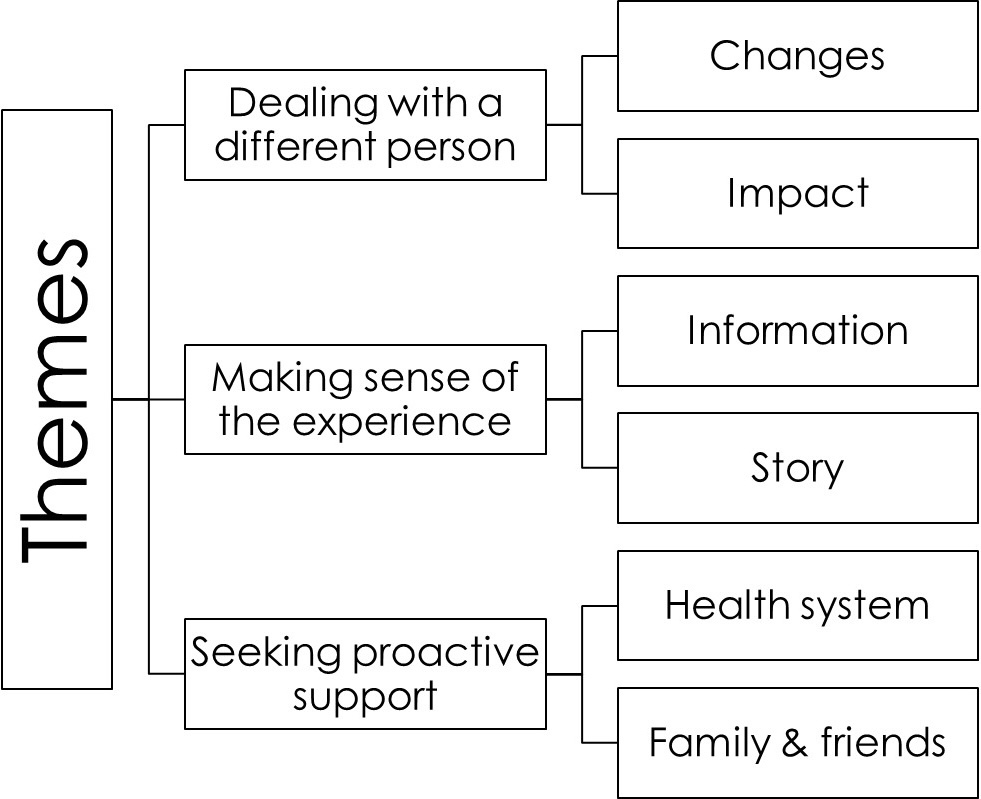
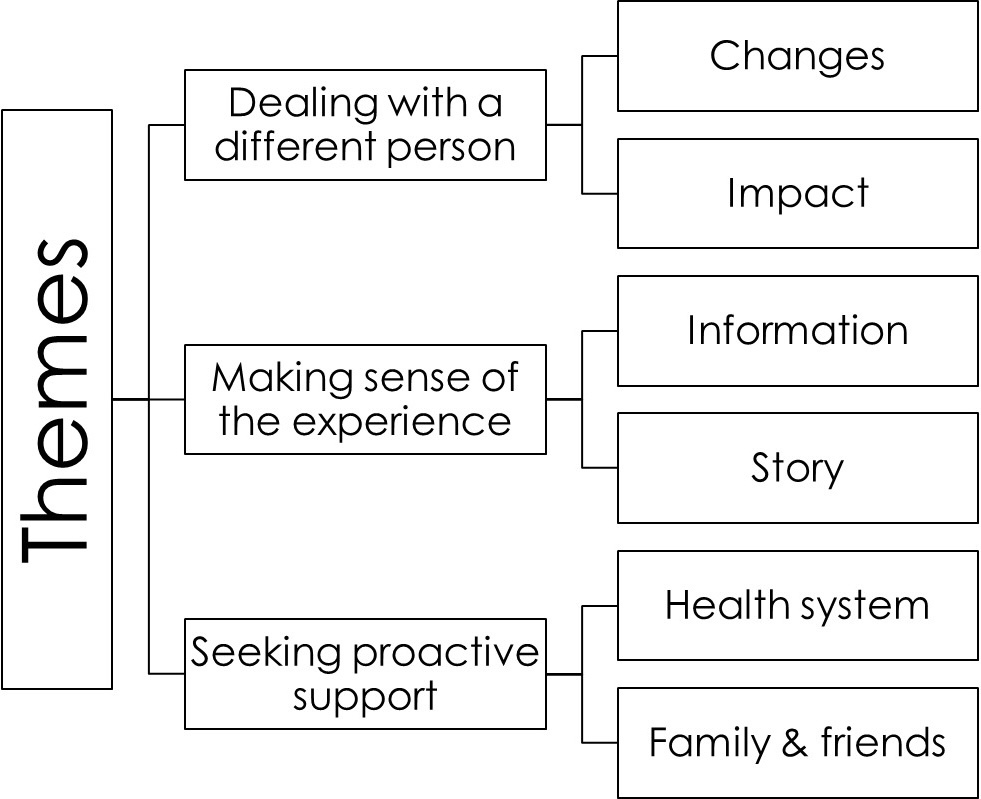
Three main themes were identified that described the experience of caring for an older person who had delirium:
-
Dealing with a different person: there were changes in the person who experienced delirium which had an impact on the life of the caregiver.
-
Making sense of the experience: caregivers desired to make sense of hospital experiences and the changes in their family member. More information and the opportunity to share their story would help.
-
Seeking proactive support: caregivers wanted proactive healthcare, and support from family and friends.
Six subthemes were identified. The relationship between the themes and subthemes are displayed in Figure 1.
Theme 1: Dealing with a different person
There were prominent changes in the person who experienced delirium, which had an impact on many aspects of the caregiver’s life.
Changes in the person with delirium
All participants stated that their family member experienced cognitive difficulties after discharge from hospital. These difficulties included confusion, disorientation, and memory problems, difficulties with language (expressing themselves) and visuospatial difficulties.
The cognitive problems meant that the person who had delirium required additional support from participants. They did not remember to take their medication as prescribed, something which was made more challenging by medication changes that were made in hospital.
He freaked out because they added all these pills, no blister pack. I was sitting here like reading each label, like which is it?
Ama – granddaughter
Participants therefore either had to remind them to take medication or convince them to take the new medication that was prescribed. Participants did not always feel sufficiently skilled to do this. For example, sometimes medication was prescribed as needed (PRN) for behavioural problems, and the family wasn’t sure when and how to administer it.
They changed his medications but didn’t give him anything regular, they just gave him medication to settle PRN. It says “when they are agitated and not before that”, but you don’t know when they are going to be agitated, and by the time you give that, for me, they’ve peaked.
Theresa - daughter
Due to the cognitive impairment, participants believed that they had to be present with their relative all the time, and that they constantly had to check up on the person with delirium to ensure their safety.
Just more caution. Always wanting to look out, making sure she is alright, calling her every day, seeing if she needs anything, how does she feel…
Mele - daughter
Family caregivers stated that the person who had delirium lost their independence due to the cognitive difficulties. They were not able to drive and needed to be taken to medical and other appointments. They were not able to maintain their personal hygiene: something family members feared could lead to another infection and another episode of delirium. The cognitive difficulties and, in some cases the residual physical symptoms of the condition that caused the delirium, resulted in them not being able to cook or perform basic activities of daily living.
Dad, who lives on his own, now has to rely on carers to help him get his showers and his basic needs done and when you’re a person who’s always lived independently, it’s embarrassing, because you got to rely on somebody to do all those personal things for you.
Marama – daughter
Most participants believed that the personality of their family member changed after discharge from hospital. Some people who had delirium were disinhibited, others displayed anger, certain people were argumentative and some displayed aggressive behaviour.
Grandpa just pushed me out of the way, he is so strong, it’s so scary and I just got a fright because he’s never done that…
Ama - granddaughter
Some people who had delirium had paranoid ideas upon discharge, but many still experienced florid delusions and/or hallucinations. Due to the paranoid beliefs, the person who had delirium often refused the prescribed treatment for physical symptoms.
One of the most common complaints was that the person with delirium was feeling fatigued after discharge. This made it difficult to get them out of the house or to engage them in pleasurable activities.
When she came back she was just not herself, always tired, wanting to go to bed, watching telly and then just not really being how she [was before].
Mele – daughter
All these changes in the person with delirium had an impact on multiple facets of the life of the caregiver.
Impact on the life of the caregiver
Caring for someone who had delirium placed multiple demands on family caregivers and had an impact on many aspects of their life and functioning. It was physically demanding, emotionally challenging and there were also significant financial implications.
Participants could not go to work due to the demands of caring for someone with delirium. Colleagues were usually understanding and supportive, but this was not always the case. Some participants ceased working because they could not manage roles as a full-time employee and caregiver.
Many participants had other dependents, such as small children or spouses with health difficulties. It was challenging to look after both the person who had delirium and other dependents.
I didn’t even have to worry about [my six-year-old son], because I could leave him with mum, and then I could have some me-time. [Now] I tell him to check on his nana and is she all right, does she need anything? Before it was definitely an easier life… now they both need somebody to look after them!
Sylvia - daughter
A participant stated how her husband, who had a physical condition which affected his mobility, felt neglected by the care she provided to her friend who had delirium. The demands of care also physically separated families.
Mum’s living here with us. Dad misses her terribly: he’s been in rehab cause he’s been having too many falls. My sister goes over there to look after him, while me and my other sister look after Mum. And so we are a family that is split trying to take care of our parents.
Marama - daughter
Caring for someone with delirium had emotional effects on participants. Participants were scared and experienced the behavioural changes and psychosis as particularly distressing. They felt sad in seeing how their family member has changed and not knowing whether they would get better.
I did find it really distressing to see one of my longest and oldest, most precious friends like this. I hoped I didn’t show her, but I was distressed […] you can see that it’s been upsetting for me. It’s the first time I’ve cried.
Jackie - friend
The extra demands made family caregivers tired, and sometimes they felt angry: at the change in their circumstances but also at the person who had delirium.
Anxious. Anger. Frustration. It’s all over the place. It’s depending on what’s going on and what’s happening. But you just take it as it comes…
Sylvia - daughter
The effect that the changes in the person with delirium had on caregivers were compounded by the fact that they did not understand these changes.
Theme 2: Making sense of the experience
In the period since their relative was discharged from hospital, participants had difficulty processing what had occurred. They believed that people with delirium and their caregivers would be able to make more sense of the event and subsequent changes if they received information on delirium and shared their story.
Information
Participants felt that they were not given adequate information: they were not given a diagnosis of delirium, and they did not know what the symptoms of delirium were.
I wished that the doctor would just say what it was. There was no real mention about the delirium, it was really just the infection.
Ama - granddaughter
Participants obtained information from other sources such as the internet, dictionaries, other people and previous experience. The information that families acquired was inaccurate and led to distress. Because participants did not know that their family member had delirium, they attributed the changes to other causes, such as mental illness or dementia.
I was talking to a friend who had quite a lot of experience with dementia in the retirement village. She felt that her [the person with delirium] reactions to us and how she was behaving could have been vascular dementia.
Jackie - friend
Families felt that written information would have been extremely helpful. They compared it to other medical and surgical conditions where they were provided with ample written information.
That’s what the children’s hospital do: they give us information about your kid [who had concussion], and it helps. Cause when they talk to you there, you just forget, it’s in one ear and out the other, but when I come back home, I read it and I know for next time […] how to look after her, not to wet her head, what to do if she seems confused…
Mele - daughter
Telling their story
Participants believed that it would be helpful for the person who had delirium and their caregivers to share their story with health care professionals, friends and family members.
Sharing their experiences helped the person who had delirium distinguish between what was real and what was delusional. It was also a form of validation to help them realize that they need not blame themselves for what happened, fill in gaps in memory, and “debrief” by sharing the traumatic experience.
Participants noticed that the person who had delirium blamed themselves for their behaviour and felt embarrassed and ashamed by it. They believed that if the person who had delirium talked about the episode, they might understand their own behaviour and stop feeling ashamed.
She blames herself because she’s of that generation that you don’t act that way. …maybe that’s what should have happened, [someone to] say “hey, this isn’t your fault”. I guess a professional would be able to say it the right way, and to guide Mum to make her feel better about it.
Rudi - son
Participants believed that talking about the experience helped people who had delirium distinguish between delusions and reality.
By explaining [her beliefs] she somehow works out that they were not true. In sharing it […] she works it out in her own brain that it is not real.
Jackie - friend
Telling their story helped people with delirium to remember things in the right order and to make up for gaps in memory that occurred.
I go through the chronological order to try and reset her mind of where she is and what’s happened and kept going back to things that she could remember.
Rudi - son
All participants described the delirium experience as “traumatic” for family members. The trauma was attributed to persecutory delusions they had in hospital (for example, beliefs that staff attempted to kill them or that they were kidnapped), poor care in hospital, and their inability to express their needs to staff. Family members believed that sharing their stories would help people who had delirium “debrief” and would alleviate distress.
Caregivers also wanted the opportunity to “debrief” as it would help them process the experiences and alleviate the intense emotions they experienced.
You being here today has helped me to share this load of things that I’ve been listening to that has been so intense and so real
Jackie - friend
Theme 3: Seeking proactive support
Family caregivers desired proactive healthcare, as well as support from family and friends to assist them in the period after discharge.
Support from the health system
Participants believed that the onus/ responsibility was on them to seek appropriate help. However, they weren’t sure where to seek help or which problems warranted seeking help for a person who had many residual symptoms upon discharge
Most caregivers were advised to seek help from the general practitioner (GP). However, the GP often did not focus on delirium or did not know about delirium because it was not indicated on the discharge summary and physical symptoms were therefore prioritized. GP practices were too busy for urgent appointments, and waiting times were long.
Our own doctors up the road here, man that place is chock full of people, all sick, all trying to get in. Sometimes it takes three weeks to get an appointment.
Marama - daughter
It was difficult to obtain urgent assistance from hospital, as the person with delirium did not want to go to hospital due to the traumatic experiences they had there.
She said to me, “I’m not coming back here [hospital] if this ever happens again - I’m not even going to tell you if I have any more of these attacks!”
Jackie – friend
Participants had various suggestions for more proactive follow-up including a phone call to check how the person with delirium was doing, someone to contact in case of an emergency and an outpatient clinic for people with delirium. However, all participants believed that follow-up should be initiated by the health system instead of putting the responsibility on family caregivers to seek appropriate help. They compared that to the proactive follow-up that people with physical conditions received.
I’ve gotten that heaps of times cause I’ve got rheumatic fever man: support, always, all day, all night, follow-ups from when I was 15 to now… I just think if the process was the same with this, it would have been a better transition than me coming home, being anxious, unsure about what I’m gonna do.
Sylvia - daughter
Support from family and friends
Participants appreciated support from friends, neighbours and colleagues, especially practical support such as driving, providing meals or checking in on the person with delirium.
Several participants were gifted meals or snacks by friends or neighbours and felt that this helped them deal with the other demands that were suddenly placed on them.
All our friends and neighbours bought food and we haven’t been able to eat some of it - our food scrap bin has been a bit fuller than it should be. So full network, been very blessed.
Yumna - daughter
Family also valued emotional support. One participant felt it helpful that her colleagues showed interest in the wellbeing of the person she was taking care of. Another participant appreciated the fact that her husband provided emotional support. Several participants valued emotional support from the person who had delirium and said that the experience improved their relationship.
In a funny kind of way it was a lovely time, because we all focussed on Dad, one on one time with Dad, it was a special time, that you’d never have if Dad was well because we are all so busy.
Jane - daughter
Friends also contributed to “having a social life” that was of real value to the caregiver. Sometimes a change of space was helpful: being able to meet at a café or go for a walk in nature. Participants felt that it provided them with some respite from the constant demands and sense of responsibility.
My whole social life got cut…because there is a feeling that you just need to be there. I think I needed to be around people that were uplifting.
Yumna - daughter
DISCUSSION
To our knowledge this is the first qualitative study that explores the experiences of family members looking after an older person with delirium specifically in the period after discharge from a hospital in New Zealand.
The qualitative approach of in-depth interviewing enabled rich insights into the experience and needs of family caregivers looking after someone who had delirium. The participants in the study were from diverse cultural and ethnic backgrounds, which is representative of the population in South Auckland, New Zealand. Interviews were conducted in the participant’s preferred setting which facilitated cultural safety, rapport and enhanced the quality of interviews.
A limitation of the study was that some people with delirium may have had an undiagnosed dementia prior to the episode of delirium, even though every effort was made to exclude them. However, as delirium superimposed on dementia is very common, this is arguably also a strength of the study, as it demonstrates the challenges that caregivers of people with delirium experienced in a real-life setting, regardless of underlying undiagnosed dementia. The New Zealand study population could limit international transferability of the findings, yet the diverse cultural backgrounds of study participants lend a common context for such research in other jurisdictions.
Our study identified three overarching themes: there are marked changes in the person with delirium which impact multiple aspects of the life of the caregiver; patients and family caregivers struggle to make sense of the episode of delirium and its effects; and caregivers seek proactive support after discharge.
The persistence of cognitive changes in the person with delirium were not surprising, as delirium often continues for some time after the resolution of the underlying causative condition11 and may lead to cognitive decline.5 Our study findings emphasized the burden that such cognitive and neuropsychiatric symptoms can place on family caregivers, as well as their need for support. The participants experienced emotions such as anger, anxiety and sadness in the period after their relative with delirium were discharged from hospital. This in consistent with research demonstrating that caregivers often observe changes in the person with delirium21 which can be distressing and provoke anxiety in people with delirium and their family caregivers.9,10,15,21,31
Participants wanted proactive support from the health system, instead of the onus being on them to seek appropriate healthcare as required. Family members of older patients with postoperative delirium wanted follow-up care to provide further explanation and monitor cognitive changes.20 Caplan et al.32 tested a “hospital-in-the home” intervention for people who had delirium and demonstrated that it decreased subsequent episodes of delirium and improved cognitive outcomes. However, there is limited research on the effects of other post-discharge interventions (such as follow-up clinics).
Clinical implications
The results of this study will help clinicians to develop an understanding of the responsibilities that are placed on family members when they are asked to take care of someone with delirium, often with little information about the disorder or prognosis.
We identified the following considerations for clinical practice:
1. The need for information
This study emphasises the importance of giving sufficient information to people with delirium and their family members. The qualitative studies that explored the needs of relatives of older people with delirium, consistently demonstrated a desire for more information on delirium.20–23 Education on delirium has been shown to alleviate distress by helping patients with delirium and their caregivers make sense of the events that occurred.33 Providing written information, and including families in discussions about delirium, could compensate for the fact that people with delirium may forget the information due to their cognitive deficits.
This study demonstrated that family caregivers often attempt to find information from other sources such as the internet. It may therefore be valuable to add the addresses of reputable websites about delirium to written information that is provided.
2. The need for clinical follow-up services
This study confirms the need for the urgent development of post-discharge follow-up services for older patients with delirium and their family caregivers, specifically for delirium and not merely the underlying condition that caused it.4,13,14 Such services should be proactive and initiated by the health system. This study demonstrated that putting the responsibility on family members leads to uncertainty, distress and delays in seeking help. Follow-up services for people with delirium could monitor cognition4,34 and provide cognitive rehabilitation.4 It can also give people the opportunity to share their story with health professionals. Such follow-up services could be delirium-specific follow-up clinics,13,14 integrated into existing memory clinics, incorporated into primary care services or involve liaison-based phone outreach. Follow-up services could be led by doctors, nurses or allied health professionals, can follow a multidisciplinary team approach or involve shared care between different teams.35 There is limited research on the optimal model of follow-up care, and this will have to be explored in future research.
An exploration of the family caregiver’s work, dependents, existing support structures and capacity to care for someone with delirium is also recommended prior to discharge.
3. The need to “debrief”
Delirium may lead to post-traumatic stress and anxiety in patients with delirium and their families10,15,36 but there are, as yet, no evidence-based strategies for the prevention of such symptoms. As demonstrated by Bohart et al17 the study participants suggested that sharing the narrative of their experiences may be beneficial for people with delirium, and may help them to make sense of the episode, to process the traumatic event and to alleviate the sense of shame that they experienced after discharge from hospital. This is particularly important as avoidance of hospital due to the traumatic experience could prohibit crucial medical treatment in future. In post-intensive care syndrome (PICS), the trauma-informed care approach recognizes ICU as a psychological trauma,37 and psychotherapy, such as cognitive behavioural therapy, alleviated distress and post-traumatic stress symptoms in patients and family members.38–40 Even though PICS encompasses more than the sequelae of delirium, delirium follow-up services could similarly be an opportunity for psychotherapy, and/or for people with delirium to share their story with health professionals, peer support workers, non-governmental organizations or others with lived experience of delirium. “Debriefing” could potentially be provided in groups in culturally responsive spaces which could contribute to a sense of belonging through shared stories and experiences.41 This should be explored in further research.
Future research
In addition to caregiver experiences, more research is needed on the experiences of older people with delirium themselves, and what people with delirium and their caregivers want while they are in hospital as well as after discharge. In order to develop follow-up services that could support people with delirium and their caregivers, research is needed on the effectiveness of any post-discharge interventions.
Conclusion
Family caregivers witness major changes in people with delirium after discharge from hospital, and they require support to deal with the additional demands placed on them. Clinicians need to provide education on delirium to both people with delirium and their family caregivers, including written information. Proactive follow-up services need to be developed for people with delirium as a matter of urgency. Such services should create the opportunity for people with delirium and their caregivers to process emotions and experiences during the episode of delirium and after discharge and help them make sense of a distressing event.
Acknowledgements
We would like to sincerely thank the participants for contributing to this study.
Declaration of Conflict of Interest
None
Declaration of Sources of Funding
This work was supported by the Health Research Council of New Zealand (grant number 22/805).
Author contributions
Engelina Groenewald, John Hopkins and Sarah Cullum conceptualized this research project.
Engelina Groenewald and Lillian Ng conducted the thematic analysis.
Engelina Groenewald wrote the first draft of this article, all authors contributed to writing the article, Sarah Cullum and Lillian Ng edited the final draft of the article.