Introduction
In clinical practice, consciousness is frequently treated as an implicitly understood yet overly simplified construct, often reduced to task-based, attention-dependent cognitive performance.1–3 Although this assumption offers practical utility, it risks masking the multidimensional nature of consciousness and, consequently, impairs diagnostic precision. This reductionism is particularly consequential in delirium, an archetypical disorder of consciousness.4,5 Defined by a disruption of cognitive function arising from physiological instability, delirium is common in hospital and of significant clinical importance.6 Despite this imperative, bedside approaches to its detection remain notably limited with respect to the broader interpretation of consciousness.5,7 Persistently low recognition rates suggest that clinicians may be constrained by a framework that equates consciousness almost exclusively with attention or other access-based outputs, without considering the broader architecture of conscious experience.
A more complete account distinguishes between two complementary modes of consciousness: A-consciousness (A), reflecting the cognitive availability and reportability of mental content, and P-consciousness (P), reflecting the subjective, experiential “what-it’s-like” character of mental states.8–10 A and P are binary, and mutually exclusive. Evidence from large-scale neural network dynamics illustrates this reciprocal relationship: inwardly directed, phenomenologically rich mentation is associated with activation of the default mode network (DMN), whereas externally directed, task-dependent cognition relies on activation of the task-positive network (TPN).11–13 These networks are functionally anticorrelated, reinforcing the view that A and P represent demarcated but interdependent determinants of conscious experience. Additionally, both A and P require a minimally intact level of Consciousness (LoC), largely mediated by brainstem function.3
Interpreting this dynamic cross-sectionally might suggest that either A or P alone is sufficient to constitute consciousness. However, such a view omits essential aspects of conscious existence. Measuring only A—common in clinical settings—ignores the experiential dimension central to consciousness.1–5 This is exemplified in the ‘philosophical zombie’ thought experiment that illustrates the anachronism of intact access-based performance without subjective experience.14,15 Conversely, P alone is insufficient: purely phenomenal experience without accessible cognitive output resembles the experience of unconstrained mind-wandering or the clinical state of akinetic mutism.3
Thus, A and P are individually necessary and distinct but not sufficient in isolation as determinants of consciousness. A unified and clinically meaningful model must integrate both, not merely as snapshots of performance or experience, but as longitudinally interacting components of an embodied system. This perspective aligns with modified interpretations of classical cognitive architectures, such as Schacter’s framework, in which A and P exhibit distinct operating constraints.16 Access-based thought can occur without concurrent phenomenal richness, whereas phenomenal contents cannot be experienced and reported simultaneously; instead, P must be transformed into A through post-hoc cognitive processes supported by higher-order prefrontal systems.17,18
Together, these factors motivate a model of consciousness that integrates the dual determinants of (A) and (P), accounts for their distinct operating conditions, and embeds them within the necessary context of LoC. The structural integrity of these interacting components defines embodied consciousness. This multidimensional model offers a comprehensive foundation for understanding delirium, and related disorders, ultimately improving clinical detection by capturing the complex interplay of these facets of consciousness.
Methods
Model Construction and Operational Definitions for Embodied Consciousness-Assumptions and Operating Principles
The next step was to construct a model of the interacting components of consciousness and to derive an operational principle for both integrity and disturbance. This serves as a template for embodied consciousness and delirium. The model is grounded in the following assumptions:
-
Intact level of consciousness:
As previously established, A and P are fundamentally contingent upon a baseline LoC. Conversely, a preserved LoC is an insufficient condition to guarantee the emergence of these higher-order states.
-
Bimodality and mutual exclusivity (moment-to-moment):
Access consciousness (A) and phenomenal consciousness (P) are distinct and equally important for embodied consciousness. At any given moment, either A or P is predominantly engaged, but not both simultaneously.
-
Vulnerability rule:
Absence or impairment of any one of the three constituents—A, P, or level of consciousness (LoC)—produces a disturbed state of embodied consciousness, regardless of the integrity of the other components.
-
Reportability vs. existence:
A occurs without concurrent P. P occurs without concurrent A, but the reporting/measurement of P is A-mediated (i.e., P’s retrospective access depends on A). This preserves the experiential status of P while acknowledging the epistemic role of A in clinical testing.
Building on these principles, we next examine the foundation for A and P integrity and conditions for embodied consciousness.
We defined a discrete state variable disc, where disc = 1 (intact embodied consciousness) only when all three conditions are simultaneously satisfied:
-
LoC = 1
-
A ≥ A* (threshold for adequate access consciousness)
-
P ≥ P* (threshold for intact phenomenal consciousness)
All other configurations—any failure of LoC, subthreshold A, or subthreshold P—are scored as disc = 0, representing disturbed embodied consciousness.
Derivation of theoretical thresholds for A and P consciousness
Candidate thresholds for A and P were derived from existing literature and from our understanding of the differential relationship between A and P-consciousness. Following Block’s “overflow” argument, we take phenomenal consciousness (P-consciousness; P) to have richer representational content than access consciousness (A-consciousness; A)—that is, the totality of what it’s like to perceive a scene exceeds what can be stably accessed, held in working memory, reported, or used to guide deliberate reasoning.9 In support of the overflow theory are partial-report paradigms where observers report far fewer items than they appear to experience, yet cueing after stimulus offset reveals access to additional item-level detail.17,18 Block interprets this as evidence that phenomenal content overflows access: the subject consciously experiences more letters than can be stabilized for report or working memory.9 On this view, P can exceed A in both magnitude and dimensionality, so a portion of P remains unaccessed (the “overflow”). Competing interpretations exist, but the core claim—that phenomenal content may be richer than what is globally accessed—remains a sound interpretation.9
Clinical Relevance of Disturbance in Access and Phenomenal Consciousness
In this model, LoC = 0 denotes coma. Lesser reductions in arousal do not by themselves exclude delirium. Because both A and P depend on a minimally adequate LoC—comprising arousal, wakefulness, and basic alertness—loss of LoC eliminates the determinants of consciousness required for any expression of A or P. In this sense, higher-order embodied consciousness (the expression of both A and P) presupposes an intact LoC, and therefore both A and P are absent in coma.
Selective A and P disruption infers a clinically meaningful state, usually without reciprocal elimination of LoC:
-
Predominant disruption of A-consciousness occurs in disorders such as dementia, where impairments in memory, executive function, language, and sustained attention reduce access-based cognitive operations.19 In many such cases, P-consciousness remains relatively preserved, especially early in the disease course; that is, the person may retain the qualitative feel of experience even when the ability to access, manipulate, or report information is compromised.
-
Predominant disruption of P-consciousness is characteristic of disorders involving alterations in the minimal self, such as schizophrenia, where disturbances of the structure or integrity of subjective experience (e.g., agency, presence, self-world boundaries) arise.20 Importantly, A-consciousness may remain relatively intact, meaning the individual can still sustain attention or perform access-dependent tasks despite having markedly altered phenomenology.
Within this aligned framework, delirium reflects a state in which both A- and P-consciousness are simultaneously disrupted, while LoC remains preserved.4 Patients are awake but demonstrate fluctuating impairments in A (e.g., unstable attention, disorganized cognitive access) alongside distortions or fragmentation in P (e.g., altered experiential coherence, misperceptions). Delirium therefore represents a disturbance in both A and P, distinguishing it from conditions that selectively impair only one dimension of consciousness.
Understanding how A and P can be jointly or selectively disrupted across coma, dementia, schizophrenia, and delirium provides a clinically actionable framework for interpreting changes in consciousness using A-proxy, P-proxy, and pre-specified thresholds (A*, P*).
Clinical Evaluation of A and P: A-Consciousness (A): Access-Dependent Cognitive Function
A-consciousness reflects the capacity to access, manipulate, and report information—the operational layer of consciousness expressed through measurable cognitive performance. In our framework, A is indexed by an A-proxy, typically operationalized using domain-based neurocognitive tests assessing attention, working memory, language, and executive control.
Numerous validated bedside and formal instruments incorporate attention, the core determinant of A, including rapid screens of delirium such as the 4AT, which uses attentional probes as markers of sustained cognitive access.21 Single-test cutoffs for attention therefore provide practical surrogate performance-based thresholds for A* in delirium (our pre-specified boundary for intact access). However, to enable a more direct comparison with studies of phenomenal consciousness (see below), we have incorporated a reference range derived from a demographically comparable healthy adult sample population.22 In that study, 1,638 residents were initially recruited, with 900 participants (425 men and 475 women) retained at 5 years; the cohort demonstrated similar mean ages (~48–50 years) and age distributions across sexes, with no significant gender differences. Using this reference, the lower bound accuracy for unmasked testing was approximately 78% (61% for masked testing). Error rates that result in less than 78% accuracy, represent a behavioural lower bound for attention, below which might be projected to represent inattention within our model. Under our earlier definitions, this maps naturally onto A ≥ A* = 0.78 as a criterion for intact access.
This alignment reinforces the principled distinction in our framework: A-consciousness is directly measurable, and A-proxy performance above A* indicates that the cognitive mechanisms of access remain functionally intact.
P-Consciousness (P): Phenomenological and Embodied Experience
In contrast, P-consciousness concerns the subjective, qualitative character of experience—the “what-it-is-like” dimension of embodied awareness.7,8 Direct falsification or objective measurement of P is inherently challenging: phenomenology is first-person, and subjective content does not admit simple verification. Questions such as “What does an apple taste like?” illustrate the absence of an objective ground truth against which experiential reports can be directly compared. Because P is not directly measurable, we use convergent behavioural proxies to derive a model that can be operationalized. Our group developed a P-consciousness assessment instrument designed to provide a systematic, clinically usable P-proxy, anchored against A-based objectivity.23 This approach allows subjective phenomenological disturbances to be mapped against concurrently measured access performance, ensuring that P-ratings are interpretable relative to the individual’s A-capacity (i.e., disentangling failures of report from failures of experience).
Early work demonstrated proof of principle support for the conceptual structure of the instrument and its anchoring to A-metrics. However, several empirical steps remain:
-
Psychometric characterization of item clusters and factor structure
-
Establishment of normative P-proxy distributions across clinical and non-clinical populations
-
Derivation of empirical cutoffs marking clinically significant disturbances in embodied consciousness (e.g., differentiating delirium from other states)
-
Mapping P-scores onto the pre-specified threshold used in our theoretical framework
Importantly, these candidate probes of (P) lack supporting clinical or biological data. The next step was therefore to explore candidate measures of (P) from the literature and use the ‘Overflow hypothesis’ to extrapolate thresholds of integrity. Mathewson and colleagues conducted a near-threshold visual detection study in which visual awareness can be considered a proxy for P, and sustained attention/vigilance a proxy for A. The analysis included 11 participants (eight female), aged 18–29 years.24 This work demonstrated submaximal and variable detection under normal physiological conditions, with trial-wise fluctuations linked to prestimulus alpha activity; in standard two-alternative forced-choice (2AFC) or staircase procedures, threshold performance typically lies around 65–75% correct. Accordingly, we pre-specified P = 0.65 as a conservative lower bound for intact P-consciousness.
These next steps will allow the tool to be fully integrated into our model, providing a robust behavioural index of P-consciousness and enabling meaningful comparisons between A- and P-derived measures.
Results
Model for embodied consciousness with Threshold specification.
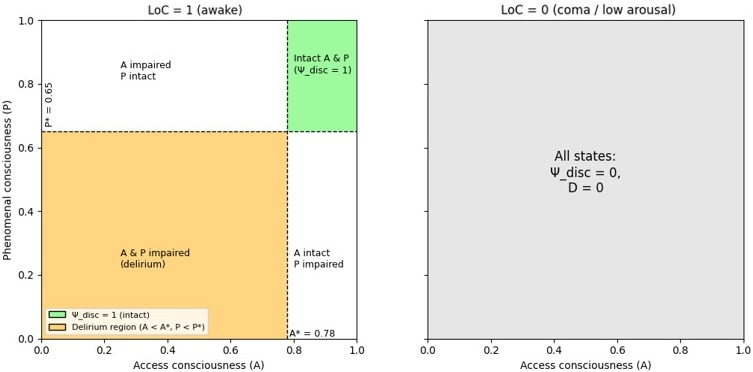
We use the lower bounds—A* = 0.78 and P* = 0.65—as pre-specified thresholds above which represents intact function.
Using these values, embodied consciousness was defined as present when:
-
LoC = 1
-
A ≥ 0.78
-
P ≥ 0.65
Operational Definition of Embodied Consciousness
To operationalize the framework, we model embodied consciousness as a discrete function of A (0–1), P (0–1), and LoC (binary: 0 = inadequate; 1 = adequate). Scores for A derive from an A-battery (including attention measures such as Vigilance A), and scores for P derive from the proposed P-C/A-C tool.23
A-proxy and P-proxy measures to be used in parallel, adhering to the structure of our model (see figure 1):
-
A-consciousness: directly measurable, objective, threshold at A* = 0.78
-
P-consciousness: indirectly measurable via structured phenomenological assessment, threshold at P* = 0.65
-
LoC: prerequisite enabling condition for the expression of both determinants
-
Overflow/dissociation logic:
-
A intact, P impaired → disorders of the minimal self (e.g., schizophrenia)
-
P intact, A impaired → access-dominant deficits (e.g., dementia)
-
Both impaired, LoC preserved → delirium
-
Both absent, LoC absent → coma
-
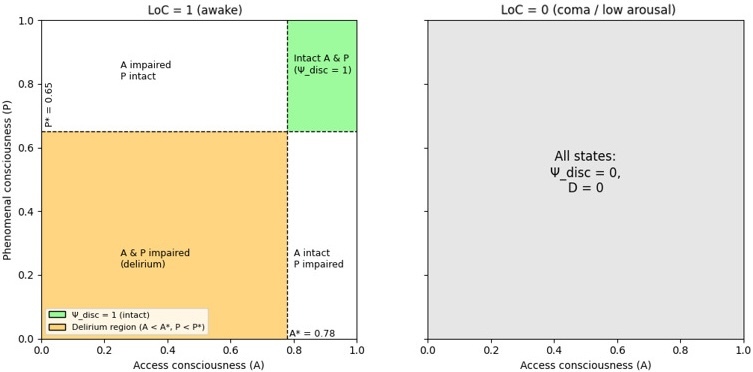
We therefore defined a Core delirium indicator, where and in keeping with DSM criteria disturbance in both A and P in the absence of coma are required. The indicator is therefore set to 1 when the following triad is present (see appendix 1):
-
LoC = 1
-
A < 0.78
-
P < 0.65
Relation to Clinical Syndromes (Risk Modelling)
We next consider the predictive validity of our threshold-based model by examining its implications across candidate clinical states. Given our pre-specified thresholds A* and P*, a direct corollary of the framework is that subthreshold A (i.e., A < A*, as seen in dementia) and subthreshold P (i.e., P < P*, as seen in psychosis-spectrum phenomena) should each independently increase vulnerability to delirium, provided that LoC = 1 (preserved level of consciousness) (see figure 2).
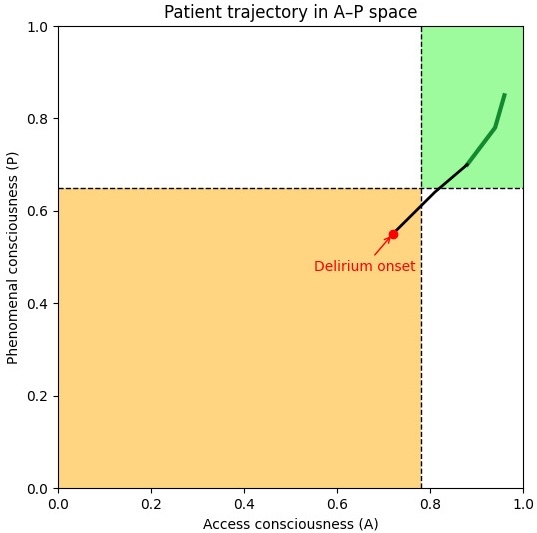
For a first-pass approximation, we treat subthreshold A and subthreshold P as independent determinants. Under this assumption, the probability that an individual meets any subthreshold condition rises when either determinant is disturbed, and the probability increases further when both are present. Accordingly, within this model, conditions primarily affecting A (e.g., dementia) and those primarily affecting P (e.g., schizophrenia or psychosis) are proposed risk states for delirium. Baseline vulnerability and acute precipitating factors have been associated with delirium risk.25
Further exploration of risk modelling
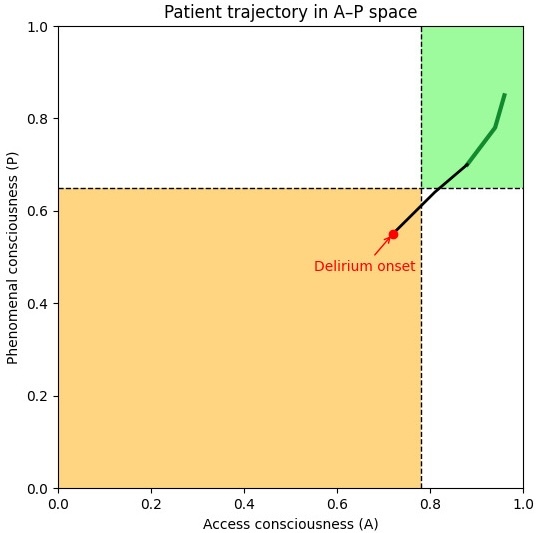
Based upon the risk states identified, of A* and P consciousness, then there are different approaches to the determination of the risk of delirium over time (see appendix 2). First, a state transition paradigm can be used, that incorporates how stressors influence transition between a finite number of clinical entities that could be interrogated further using Markov modelling to estimate how stressors increase the chance of moving into a delirium state. Second, we can interrogate risk of delirium in terms of distance to threshold approach where proximity to failure in the respective dimensions of consciousness is calculated. The closer either A or P nears the threshold—especially if both are drifting down—the higher the predicted risk, producing a smooth “risk surface” across the A–P plane that can later be evaluated and calibrated against real clinical outcomes (see appendix 2).
Discussion
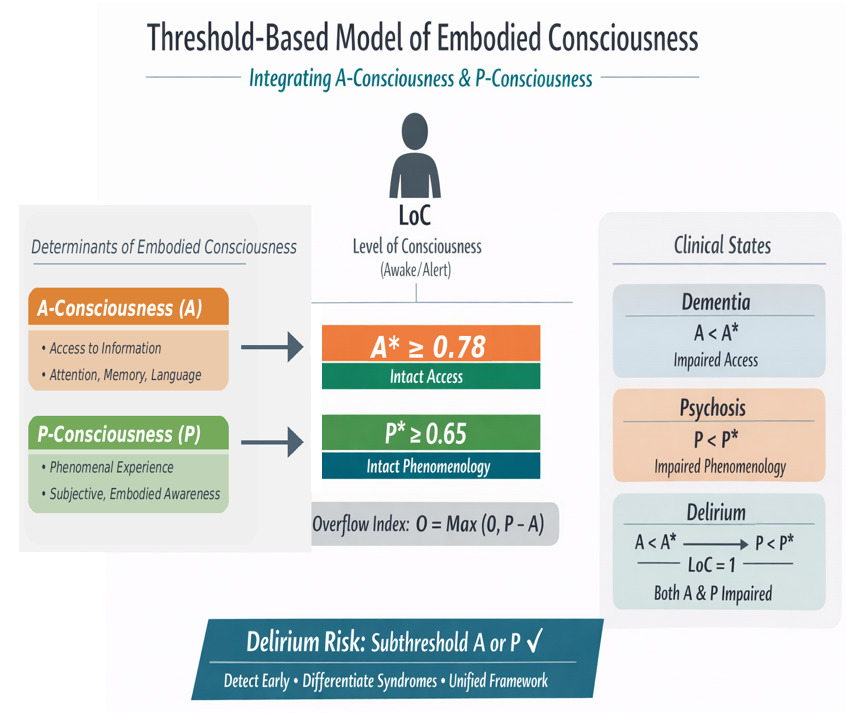
This threshold-based framework conceptualizes embodied consciousness as the joint expression of A-consciousness (A)—the capacity for access-dependent cognition—and P-consciousness (P)—the structure and coherence of subjective experience—under a preserved level of consciousness (LoC). By specifying thresholds (A* and P*), the model provides a principled structure for interpreting disturbances in consciousness across diverse clinical states (see figure 3).
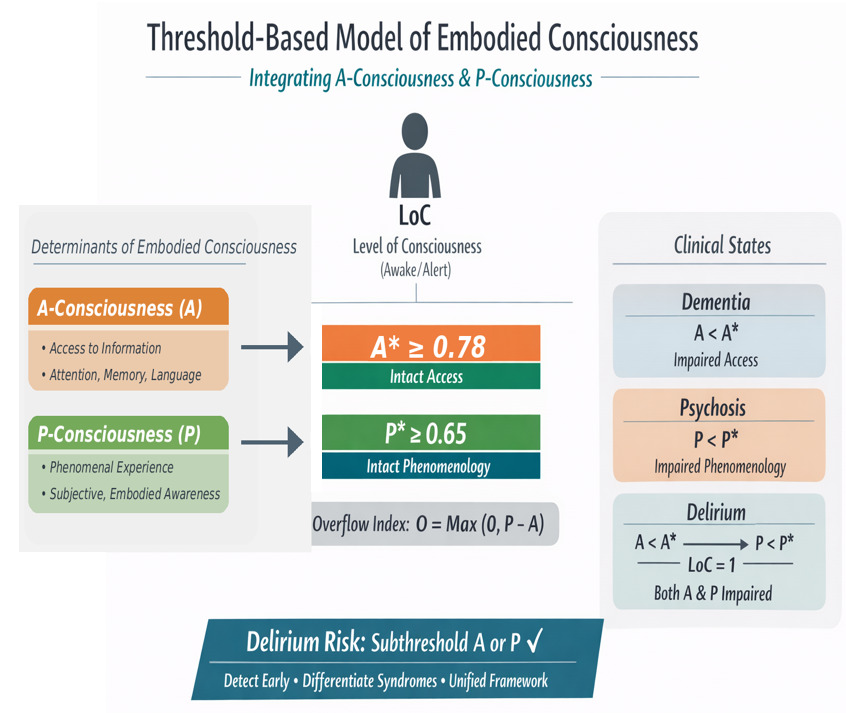
A direct implication of this architecture is that subthreshold A or P independently increases vulnerability to delirium, if LoC remains intact. Disorders such as dementia (A disturbance) and psychosis-spectrum conditions (P disturbance) therefore represent independent risk states within this framework. The proposed contribution of A and P disturbances to delirium risk requires empirical testing. Under a first-pass assumption of independence between A and P disturbances, risk accumulates additively: individuals with deficits in either determinant have a lower margin of resilience against the additional acute stressors. The Stress-Vulnerability model provides an aetiological framework for delirium that must occur through direct disruption of A or P, or via shifts in the threshold for their breakdown.25 In either instance, we argue that the conceptual framework should be preserved.
The model also highlights conceptual tensions and potential limitations. First, the high co-occurrence of dementia and psychosis without delirium in the clinical setting challenges the conditions for delirium manifestation inferring incomplete necessity, potential non-independence, and the crucial role of precipitating stressors. This tension may reflect diagnostic and measurement limitations. Delirium is frequently under-recognized in individuals with baseline cognitive impairment or chronic psychiatric symptoms. Consequently, many cases of so-called “dementia with psychosis” may include resolving or subsyndromal delirium or a clinical state where the two are indistinguishable using traditional diagnostic categories.26,27 The threshold model therefore underscores the need for parallel measurement of A- and P-proxies, enabling finer discrimination between diagnostic entities and superimposed, state-level perturbations of consciousness. Additionally, whilst we have used psychosis and schizophrenia interchangeably this may be misleading and inaccurate. Because the foundational framework of self-disturbance is rooted in schizophrenia, its translation to dementia-associated psychosis introduces diagnostic asymmetry. Dementia-related psychosis is a highly heterogeneous entity, limiting the validity of this cross-diagnostic comparison.
Second, it should be stressed that the feasibility and testability of P-Consciousness probes have not been evaluated in delirium where the real-world setting of co-existent dementia and sensory abnormalities are common. Reassuringly, preliminary evidence suggests that visually based, phenomenology-driven approaches can capture elements of P-consciousness with meaningful clinical validity.28,29
Third, the scope of the constructs is incomplete. Although the model is embodied and bidimensional (A and P), additional constructs (e.g., metacognition, self-temporality, time perception) may contribute to higher-order synthesis and are excluded. Some domains (e.g., time orientation) arguably blend A and P aspects of self-temporality, with an argument that because time perception is also fundamental to delirium likely warrants explicit inclusion.30,31
Fourth, the measures derived for A- and P-consciousness differs fundamentally in their construct and taxometry. Clinical evaluation for the determination of A-consciousness thresholds was undertaken using direct clinical assessment in a large community population. This contrasts with indirect EEG derived proxies for P-consciousness in a small sample of young adults. Further, A-consciousness lends itself to continuous measurement with normative values and well-defined thresholds. By contrast, P-consciousness is better conceptualised as a multidimensional space defined by the richness, complexity, and structure of subjective experience rather than along a single quantitative axis. For pragmatic clinical purposes in the assessment of delirium, however, P-consciousness has been operationalised here as a binary (present/absent) construct. As a result, simple scalar or dichotomous metrics can only provide a low-resolution approximation of this domain. Within this framework, binary items (e.g., the ability to generate novel imagery) function as threshold probes of preserved phenomenological capacity. More refined approaches will require the development of graded measures capable of capturing the multidimensional structure of P-consciousness. Accordingly, we treat A- and P-consciousness as distinct constructs requiring different measurement approaches—continuous versus binary. We acknowledge, however, that relating these constructs risks conflating fundamentally dissimilar properties, which may threaten validity.
Other potential issues within the model include a challenge of the assumption that A and P consciousness are truly discrete. Functional studies demonstrate an anticorrelation (between DMN and TPN) but not a strict binary separation.11–13 Perhaps most significantly, the model presupposes the ontological existence of phenomenal consciousness. Conversely, it may be argued that (P), represents a latent construct emerging from cognitive processes subsumed within access consciousness (A). Furthermore, the operational parameters and derived thresholds upon which this framework depends rely on assumptions inherited from the ‘Overflow hypothesis’—a proposition that remains largely a theoretical construct born of the philosophy of mind.
Lastly, an apparent but underexplored paradox emerges in our proposed relationships. A- and P-consciousness may function as separable, threshold-level contributors to delirium onset. However, once delirium develops, they appear to behave in a highly interdependent manner, with strong coupling between access and phenomenological disturbance. Thus, the subthreshold distinction collapses at the point of clinical expression. This is consistent with observed network-level convergence between neurobiological substrates of A- and P-consciousness, and also aligns with the experiential maladaptive duality of delirium.31,32 This seemingly counterintuitive behaviour is however characteristic of critical transitions in biological systems—such as seizure dynamics and large-scale neural synchronisation—where increasing coupling drives a collapse in effective dimensionality and the emergence of a constrained dynamical state. In this framework, delirium reflects a shift to a pathological attractor, in which loss of degrees of freedom forces A- and P-consciousness—previously separable dimensions—into a tightly coupled, lower-dimensional regime with reduced effective complexity and disruption of the normal balance between segregation and integration.33 Delirium may therefore be understood as a manifestation of system-level complexity failure, in which higher-order integrative functions—most notably consciousness—are preferentially compromised.34
Nevertheless, despite these theoretical limitations, this work represents a paradigm-shifting endeavor; it is, to our knowledge, the first explicit attempt to operationalize and formalize the architecture of consciousness specifically as it relates to delirium. Crucially, this highly original, model is immediately amenable to empirical testing in clinical environments. It establishes an entirely new foundation for parameter estimation, performance characterization, and the systematic refinement of delirium diagnostics. More broadly, the subthreshold model reframes delirium as a two-determinant failure—a concurrent collapse of cognitive access and phenomenological coherence in the context of wakefulness—rather than as a purely attentional or global cognitive disorder. This offers a unified explanatory structure across the diverse psychomotor presentations, heterogeneous aetiologies and inherent fluctuation of delirium.
By integrating objective measures of A with structured assessment of P, this framework may yield a more precise, mechanistic understanding of delirium and related disturbances of consciousness. Future work should focus on empirically validating the A* and P* thresholds, establishing the psychometric behaviour of the P-proxy instrument, and evaluating the model’s predictive performance longitudinally.
Acknowledgements
Cai Fong for conversations concerning the perception of time and Stephanie Yerkovich for mathematical support
Author Contributions
Eamonn Eeles was responsible for overall conceptualization and original write-up, Julian Ray provided support for conceptualization and editing, David Tran also provided conceptualization and methodology support and Phillip Karpati provided mathematical modelling.
Ethics statement
There were no human studies and so ethics was not required.
Funding sources
There were no funding sources for this manuscript.
Data Availability
Data sharing is not applicable to this article as no new datasets were generated or analysed during the current study.
Declaration of Interests
Eamonn Eeles is an editor of Delirium. Alasdair MacLullich handled this manuscript. The authors declare no other conflicts of interest.