Introduction
The American College of Surgeons defines high-risk older surgical patients as those with frailty or ≥ 85 years.1 These patients face a heightened risk of postoperative delirium (POD), a complication linked to significant adverse outcomes.2 While bundled multicomponent interventions can prevent POD, their resource demands remain a challenge, especially with nursing shortages. Identifying simpler, effective strategies is essential. A recent network meta-analysis identified reorientation as a key component.2 This quality improvement (QI) project investigated the impact of a standardized reorientation protocol in the Post-Anesthesia Care Unit (PACU) on reducing early POD in this vulnerable population.
Methods
This QI project received institutional review board approval and compared outcomes in two prospective cohorts of high-risk older surgical patients before and after a reorientation intervention. Elective surgical patients over the age of 65 years were assessed for frailty in the preoperative clinics by trained staff using the Edmonton Frailty Scale.3 Eligibility criteria included high risk patients (age ≥85 years or age ≥65 years with an Edmonton Frailty Score ≥63 within six months before surgery) undergoing elective surgery with at least one overnight hospital stay and negative POD screening immediately preoperatively. The 4 A’s test©4 was used to screen for delirium. The 4A’s test was routinely administered preoperatively and each 8- hour shift postoperatively on the surgical wards by the nursing staff in all patients aged 65 years and older. Exclusion criteria included additional surgeries during the index admission, direct postoperative admission to the intensive care unit, and preoperative screening positive for delirium.
In the pre-QI cohort, the frequency of PACU reorientation was not standardized and was based on nursing clinical judgement per American Society of Peri-Anesthesia Nurses guidelines.5 The QI initiative standardized the timing of reorientation in the PACU, based on the American Society of Anesthesiologists guidelines (≥1 reorientation within the initial two PACU hours, with subsequent periodic reorientations for longer stays).6 The QI reorientation intervention was standardized, using 4 to 5 questions with repeated prompting when needed.7 With the help of the PACU charge nurse, we trained the nursing staff on how to deliver the intervention and document it in the electronic health record. The study team also met with PACU nurses weekly to support adherence and address any issues.
Postoperative care following PACU discharge included standard hospital protocols involving interventions such as reorientation, medication adjustments, early mobilization, and in some patients co-management by a geriatric team. This QI project focused solely on early interventions by the anesthesia and PACU teams. We evaluated the effects of PACU-based reorientation, but did not standardize or influence any care provided after the patient left the PACU.
Frequency of PACU reorientations were compared pre-QI and during the QI period.
The primary outcome was the 4 A’s test score on postoperative day 1, dichotomized as ≥4 (possible POD ± cognitive impairment) or <4 (no POD). This primary outcome was chosen to capture the period most likely to be influenced by our intervention, which was implemented in the PACU and was directly controlled by the study team. While delirium can develop over several days, this study focused on early onset due to the limited scope of our QI initiative. Loess smoothing visualized POD risk changes. Logistic regression with time-segment variables (months before/after implementation) calculated odds ratios (OR) for POD, adjusting for age, gender, anesthetic type, surgical type, co-morbidity, and race. Firth’s penalized likelihood corrected for rare event bias; all ORs are presented with 95% confidence intervals (CIs).
Results
In the pre-QI cohort, of 443 patients screened from 12/1/2018-2/28/2020, 76 had Edmonton Frailty Scale ≥ 6. In the QI cohort, of 477 patients screened from 7/1/2020-10/29/2021, 102 had Edmonton Frailty Scale ≥ 6. The pre-QI and QI cohort demographics were generally similar, except for a higher proportion of females (39% versus 66% in pre-QI and QI, respectively, p < 0.001) and mix of surgical cases (general/orthopedic/vascular surgery (25/13/43% vs 25/27/25% in pre-QI and QI periods, respectively, p = 0.03)) (Table 1).
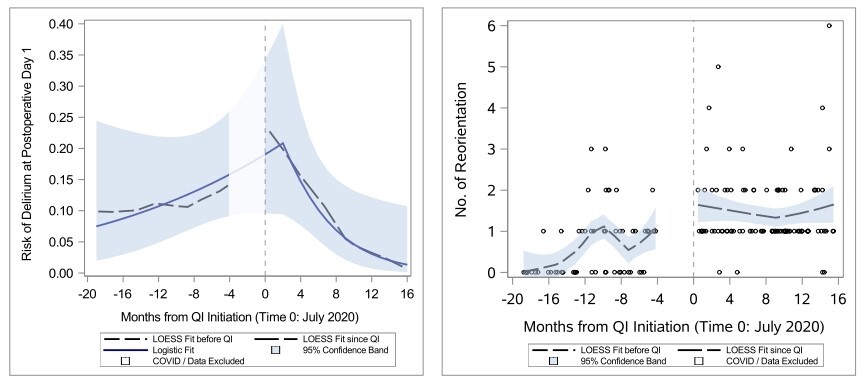
In the pre-QI cohort reorientation was inconsistent (Figure 1, right), with many patients not receiving reorientation. In the QI cohort, both the raw number of reorientations (0.6 ± 0.8 vs 1.4 ± 1.0 PACU reorientations in the pre-QI and QI cohorts, respectively (p < 0.001, t-test)) as well as the standardized per hour reorientations increased (0.3 ± 0.4 vs 0.5 ± 0.3 reorientations/hour in the pre-QI and QI cohorts, respectively (p = 0.001, t-test)).
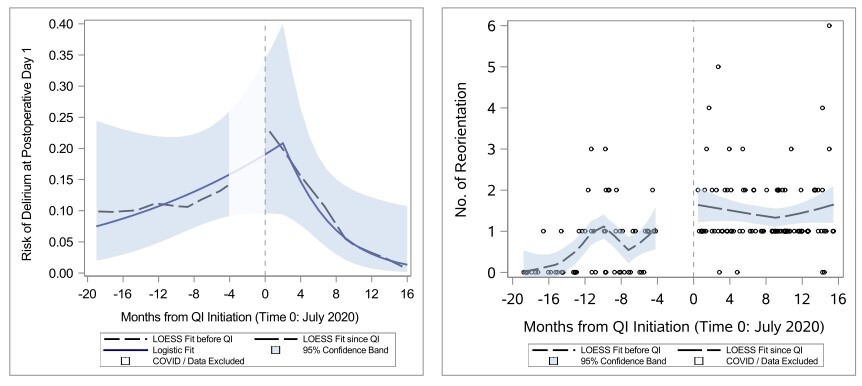
In the pre-QI cohort postoperative day 1 possible POD ± cognitive impairment ranged from 10% to 12%. During the period of QI protocol implementation Loess fit demonstrated a slight upward trend before and rapid decrease soon after in postoperative day 1 POD risk over time (Figure 1, left). This finding was supported by regression analysis showing that postop day 1 POD ± cognitive impairment decreased over time (adjusted OR 0.75 [95% CI 0.58 – 0.96]; p = 0.02, per month progression) during the period of QI protocol implementation.
Discussion
This QI project suggests that standardized PACU reorientation is associated with a reduction in early POD among high-risk older surgical patients. This finding aligns with best practice guidelines that early PACU interventions can be a valuable component of perioperative care for this vulnerable group.
A key consideration for any new intervention is the potential burden on busy staff. While our study didn’t measure long-term outcomes like a patient’s length of stay, PACU nurses found the reorientation protocol to be a feasible addition to their workflow. They reported that the brief, structured intervention was manageable as long as it didn’t require constant repetition or compete with other time-sensitive tasks. This feedback suggests that a focused reorientation strategy could be a practical and scalable intervention.
This study has several limitations. First, we did not assess the quality or difficulty of reorientation efforts. In some high-risk older patients, factors like residual anesthesia or opioids can reduce their ability to respond, making reorientation challenging. Future research should explore how to make these interventions more effective in such patients, perhaps by tailoring anesthesia dosing. Second, we lacked formal baseline cognitive testing. While we used a preoperative delirium screening tool (the 4A’s test), a comprehensive cognitive assessment wasn’t feasible for this quality improvement (QI) project, which was designed to avoid the need for written consent. Future studies should include detailed cognitive evaluations to better characterize the patient population and more accurately assess the impact of reorientation. Finally, the COVID-19 pandemic significantly delayed the start of the reorientation protocol due to decreased surgical volumes. The intervention was implemented gradually as case volumes recovered, which impacted the rollout. We addressed this by using LOESS smoothing in our analysis to capture the gradual improvement in implementation over time, rather than a simple before-and-after comparison, which would have obscured our team’s learning curve. This method provides a more accurate reflection of the intervention’s impact as adherence and effectiveness increased.
While these single-site results are promising, larger, randomized controlled trials are needed to confirm our findings and optimize implementation strategies. Further research should also evaluate the intervention’s broader clinical impact and its sustainability across diverse healthcare settings.
Disclaimers
None
Conflicts of Interest
The authors declare no conflicts of interest.
Source(s) of Support
Internal grant from Johns Hopkins Department of Anesthesiology